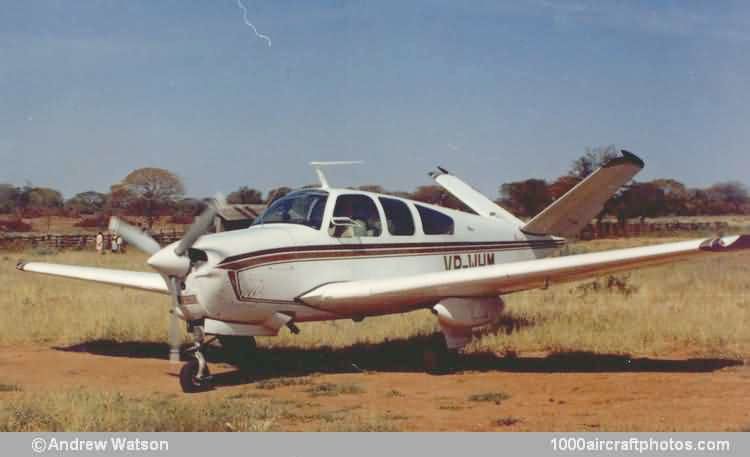
11/26/2002. Remarks by
Andrew Watson: "My father acquired this Bonanza in 1977 as a replacement for the first airplane he owned, a Piper Cherokee 235 which looked like
this one, that my brother Spencer photographed for me, since we had no photos of Dad's plane. The Cherokee was destroyed by ZIPRA (Zimbabwe People's Revolutionary Army), one of the two guerilla forces fighting against the Rhodesian government in the civil war that took place 1964-1979.
The Bonanza provided 'top cover' for convoys, as well as a first strike aircraft for incidents in the West Nicholson/Beit Bridge area of Rhodesia (now Zimbabwe) during the Rhodesian Bush War in the 1970s. Matabele Air in Bulawayo, Zimbabwe, did the conversion in 1979.
The guns are not all that apparent - they are in pods
under the wings, beside the wheel wells. Nevertheless, to anybody who knows anything about Bonanzas, the pods will be very obvious. If you look carefully, you can see the tips of the barrels sticking out from the pods. The brownings were fed by two 600 round ammunition trays that were recessed into the wings. The guns themselves were on their sides, which not only allowed easy opening of the breeches, but it also facilitated the ejection of the spent cartridges through a slot in the side of the pod, as well as the gathering of the belt links in the bottom of the pod, which were then re-used.
The guns were fired by solenoids which were activated by a push-to-talk button on the control column. The sighting mechanism was very simple, yet effective. A fold-out arm with a ring sight on it was snapped into place. A dot on the windshield provided the second reference - line up the dot in the ring, put both on the target and press the trigger.
A further modification was done to the aircraft - unfortunately I don't have any photos of it - which provided my father the ability to drop a series of three or five grenades from the bottom of the aircraft. Basically, there was a hole in the floor (which was normally sealed with a resin plug) between the co-pilot's feet. The grenades were stored in steel tubes in a removable armoured box right behind the pilot and observer, directly over the C of G. All pins were removed from the grenades; the handles were held in place by the walls of the tube. The tube was blocked on both ends by means of two large steel pins, and locked in place by split pins (re-used from the grenades). A spring loaded cap was fitted to the top-end of the tube.
At the required time the resin plug was removed from the floor and the tube was attached over the hole in the floor and locked in place. The top pin was removed causing the spring loaded cap to exert pressure on the grenades. A cable was attached to the bottom pin by means of a dog-leash clip. On final approach to the target, the bottom safety pin was removed. Once over the target, the cable was pulled, removing the bottom pin and causing the spring loaded cap to force the grenades from the tube. A further safety device was available and used in the event of a 'hang-up' in the tube. I had to use it on two separate occasions. While not very scientific it worked... Dad would hold the aircraft very steady and I would carefully remove the spring loaded cap, take a small pole (cut from a mopane tree) and push the hung-up grenades out the tube.
The aircraft saw a fair amount of action; Dad was awarded a Meritorious Conduct Medal for his efforts. At the end of the war the aircraft was returned to its 'civilian' state in about 1983. Eventually the aircraft was reregistered Z-WHM (Zimbabwe) and was sold after my Dad died in 1990. To the best of my knowledge, it was the only V-tail Bonanza to be equipped in such a manner."