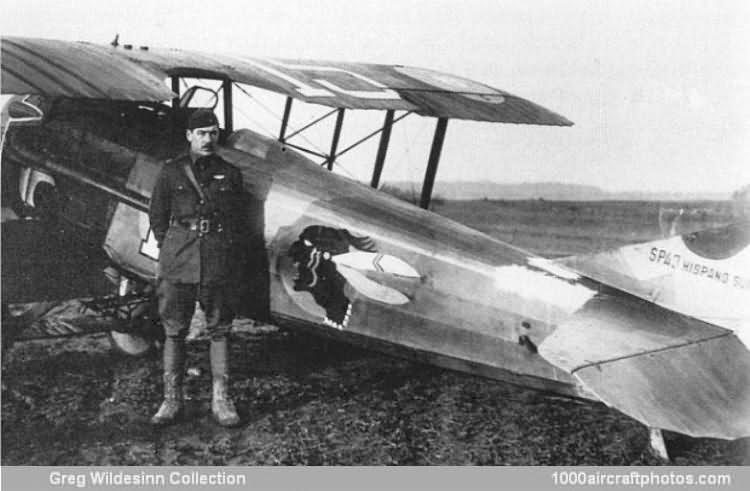
10/15/2005. Remarks by family of Robert Lockerbie Rockwell: "Robert L. Rockwell (pictured above) was the 15th volunteer member of the Lafayette Escadrille (Spa124) in France before entering the USASC during WW I. He was a distant cousin of another Escadrille member, Kiffin Rockwell, the first American in the Escadrille to shoot down a German aircraft.
Rockwell's training began at Pau, France in February 1916 and he received is "Brevet Francais Militaire' at the flight school at Buc in the Blériot aircraft in May, 1916. In September 1916, while in Paris, Rockwell was selected by the French commander of Lafayette Escadrille to replace Victor Chapman, the first American killed in combat with the Escadrille, shot down by Manfred von Richthofen. He flew patrols and fighter escort missions in the Nieuport 17 out of Luzeuil in the Vosges sector of the front.
In May 1917 Rockwell received the Croix de Guerre avec Palme (War Cross with Palm) as a result of combat in which his Nieuport received serious damage. He had dropped down behind a group of seven German fighters which then swarmed him. After returning to his base he counted 27 bullet holes on either side of his cockpit and numerous other hits all over the plane. In June 1917 his squadron received SPAD S.VII fighters. In August the squadron was flying 3 sorties per day for 24 days without interruption.
On September 24 the engine of Rockwell's SPAD failed while flying above a German formation. He plunged the aircraft through the German formation. His oil radiator burst spewing castor oil over his windscreen and goggles. Nearly blinded and with an enemy formation now on his tail, Rockwell continued in an extended dive hoping his pursuers would think him dead and break away. His ruse worked and he nursed his plane back to base. He was awarded a second Croix de Guerre.
Rockwell was promoted to Captain on January 31, 1918, just before the Escadrille passed out of existence. On February 20, the 103rd Aero Squadron was formed at La Noblette, France, from American pilots of the Lafayette Escadrille. It served with the French Air Service until April 10, 1918, and on July 1 the squadron became a part of the 3rd Pursuit Group of the USASC (USAAS from May 23), included the 28th, 93rd, 103rd and 213th Pursuit Squadrons. Subsequently the SPAD S.VII was replaced by the SPAD S.XIII C1.
Rockwell was commanding officer of the 93rd Pursuit Squadron (PS) at Toul near Nancy, from July 29 to October 18, 1918, during which time the photo above was taken. At the end of the hostilities Rockwell had seven unconfirmed enemy aircraft kills, and the 93rd PS was demobilized in March 1919. After 20 years of various civilian occupations, Rockwell returned to service in 1939 as a Colonel in the USAAC, serving with distinction in many assignments until his retirement from active duty in 1946. He died at San Bernardino, California, on January 24, 1958."
Read the type remarks on page
13601.