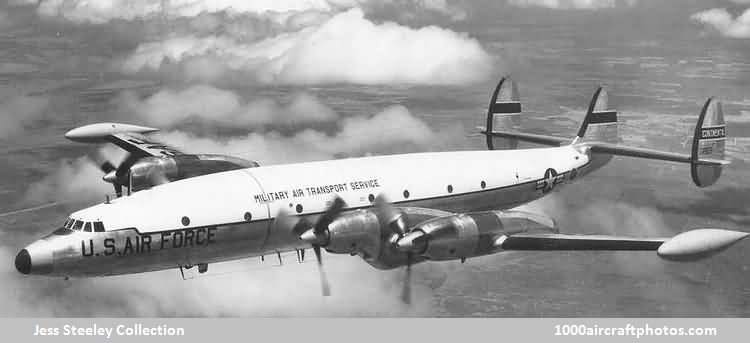
11/15/2005. Remarks by Jess Steeley: "In 1951 Lockheed started design of the R7V-2 powered by the YT-34-P-12A turboprop rated at 5,500 eshp driving three-bladed Hamilton Standard Turbo Hydromatic propellers. 22,000 eshp is some serious horsepower for a Connie, compared to the 13,000 hp from the reciprocating engines that powered the R7V-1. The T-34 was to power the Douglas C-133 Cargomaster.
Four R7V-1s (BuNos. 131630/131631/131660/131661, c/n 1249A-4131/4132/4161/4162) under construction were modified to R7V-2s, the first to fly was 131630 on September 1, 1954. With 440 mph (708 kmh) the R7V-2 was the fastest prop-driven transport in the world at that time.
Two of the R7V-2s, BuNos. 131660/131661 were turned over to the USAF as YC-121Fs, s/ns 53-8157/8158. The latter was leased back to Lockheed to become the test bed for the Allison 501D turboprop, the civil version of the T-56 that already powered the YC-130 Hercules. The 501D was the intended power plant for the Lockheed 188 Electra, hence the YC-121F was nicknamed "Elation". After the trails the aircraft was fitted with 6,000 eshp T-34-P-6 engines and returned to the USAF.
After it was struck off charge by the USAF the fuselage was used to rebuilt 1049G c/n 4636 Flying Tiger Line N9749Z (later N174W) to 1049H, resulting in an unusual configuration with the round windows of the 1249A. It was written off at Barrow, Alaska, USA while being operated by North Slope Supply Co, Inc., on May 5, 1970."