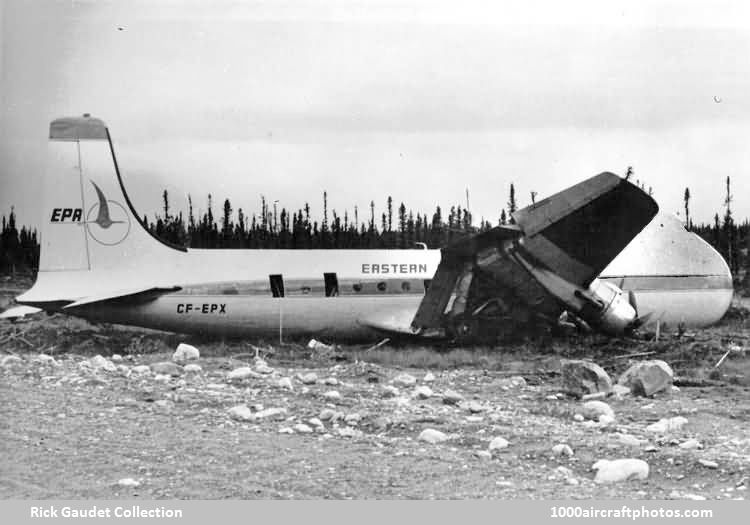
Photographed near Twin Falls, Newfoundland and Labrador, Canada, September 1968, from Bert Lambert
08/12/2006. Remarks by
Jack McKillop: "Originally, Douglas built this aircraft as a C-54A-5-DO Skymaster, USAAF s/n 42-107461, c/n 7480, and delivered it to the USAAF on April 11, 1944. After the war, American Airlines purchased it on April 10, 1946, converted it to a DC-4 passenger aircraft and placed it in service registered NC90431, named "Flagship Philadelphia". On January 1, 1949, the "C" was dropped from the registration and it became N90431.
On September 24, 1954, this DC-4 was bought by Airplane Enterprises who sold it to the Venezuelan airline AVENSA (Aerovias Venezolanas Sociedad Anonima) in October 1954 and registered it YV-C-AVH. Three months later, the US charter company Resort Airlines of Washington, District of Columbia, purchased the aircraft and registered it N75298. World Airways, a supplemental carrier, leased this DC-4 between July 1, 1960 and June 27, 1961. In May 1962, the British company Channel Air Bridge bought the aircraft and registered it G-ARZV.
Aviation Traders converted the DC-4 to an ATL-98 c/n 6 and it made its first flight on December 21, 1962. The aircraft was sold to Ireland's Aer Lingus Teoranta on Feburary 28, 1963, registered EI-AMP, and named "Ailbhe" (St. Albert). Aer Lingus purchased three ATL-98s because tourists between the UK and Ireland wanted to take their cars with them on vacation (holiday) and there were no roll-on roll-off ships. These ships were introduced in 1966 and Aer Lingus eventually sold all three, this one to Canada's Eastern Provincial Airways (EPA) of Gander, Newfoundland and Labrador, in February 1968. As described below, the aircraft crashed on an approach to Twin Falls on September 28, 1968."
04/30/2006. Remarks by
Tony Avis: "CF-EPX was previously EI-AMP with Aer Lingus. I would be a bit surprised if the engine and electrical problems the aircraft suffered were due to storage in Ireland as all three Canadian carvairs were checked and overhauled at Southend prior to delivery to Canada. It wasn't unknown for the BUA/BAF Carvairs to return from time to time on three engines so I suspect many of the problems experienced in Canada were simply down to operating old and hard worked aircarft in a harsh climate."
02/28/2006. Remarks by
Rick Gaudet: "EPA had three Carvairs: CF-EPX c/n 7480 ATL 98/6, CF-EPW c/n 10458 ATL 98/14, and CF-EPV c/n 10448 ATL 98/8 (information from Aircraft Illustrated, October 1979). All three aircraft were stored in Dublin, Ireland with Air Lingus and came to EPA in 1968 and used on the inter-Newfoundland runs from St.John's, Gander, Deer Lake, and into Labrador in a mixed passenger/cargo operation.
These aircraft were very unreliable in EPA service and had frequent mechanical problems with the engines and electrical snags. Some say this was due to the aircraft sitting on the ramp in the wet damp climate in Ireland.
CF-EPX apparently undershot the dirt strip at Twin Falls on September 28, 1968. The aircraft went around for a second attempt with the landing gear quite damaged and hanging down. The Captain was Ivan Delong and the Flight Officer was Dave McNeil. The flight attendant was (I think) Ms. Heather Dawe.
As far as I know there were no serious injuries. The photo of CF-EPX is from Bert Lambert who was the EPA Station Manager at Churchill-Falls for many years. He advised that the aircraft was stripped of all useful equipment and then burned. The remains were subsequently plowed under and buried.
The remaining two Carvairs were were mainly used for cargo work between Moncton, New Brunswick, Goose Bay Labrador and Wabush, Newfoundland, if I recall correctly. They then were parked at the EPA hangers at Gander, Newfoundland for a number of years and sold to Aviation Traders in 1973. They were superceded by Boeing 737 aircraft.
Apparently, the flight deck from CF-EPV was housed in the US 8th AF museum at Fritton, Norfolk, UK.
There is in existance a folksy ballad regarding the crash of this aircraft called The Ballad of EPX."
01/02/2004. Remarks by Jodi DeLong: "My father, Captain Ivan DeLong, crashlanded this Carvair in Twin Falls when the landing gear collapsed. No one was injured, though the plane didn't fare awfully well. Dad used to train other pilots on CF-EPV, and I went with him in the jumpseat several times. My father, and other pilots, referred to the plane by a host of nicknames, ranging from the
"Intercontinental Ballistic Blob" to the
"Humpty Backed Camel" to the
"Lumbering Lizzie", but she was most often referred to as the
"Blob". My father went on to captain EPA's Boeing 737s and went through EPA's transition to part of Canadian Pacific and finally Canadian before retiring in 1992."