02/08/2026. Remarks by
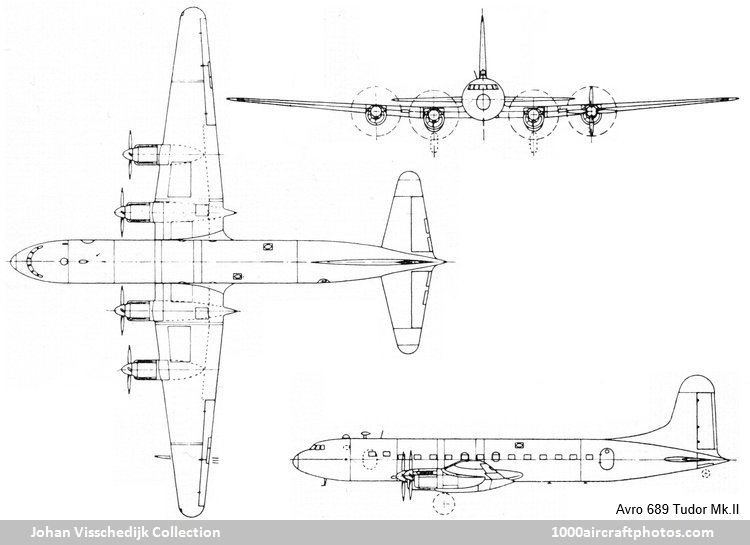
Johan Visschedijk: "The Tudor Mk.II (or Avro XXI) was designed originally as a stretched version of the
Tudor Mk.I to carry 60 passengers for BOAC as the Avro 689 and for BEA as the Avro 699. To this end the fuselage diameter was to be increased by 1 ft (0.30 m) and the length by 25 ft (7.62 m), with the flying surfaces, powerplants and undercarriage remaining unchanged. In November 1944, while the aircraft was still in the design stage, BOAC, QANTAS and South African Airways decided to standardize it on all the Commonwealth routes and the original BOAC order for fifty was increased to 79. By May 1945, however, aerodynamic considerations and the operators' changing requirements had increased the length to no less than 105 ft 7 in (32.18 m), making the Tudor Mk.II the largest aircraft produced in Britain up to that time.
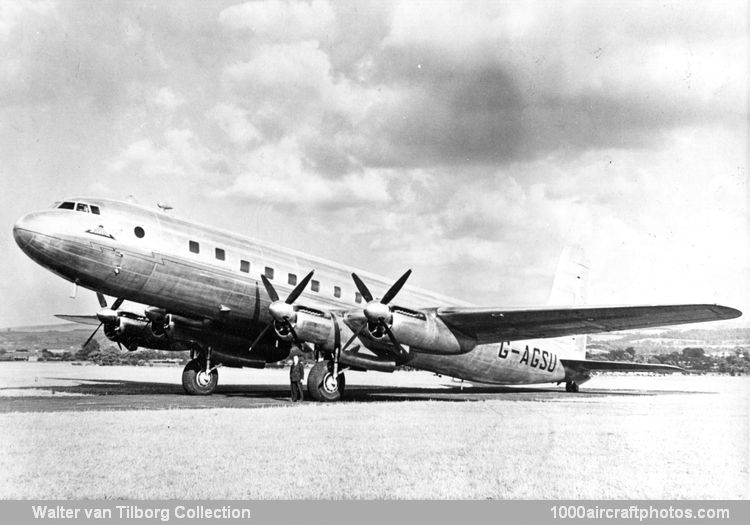
(G-AGSU) (
Walter van Tilborg Memorial Collection)
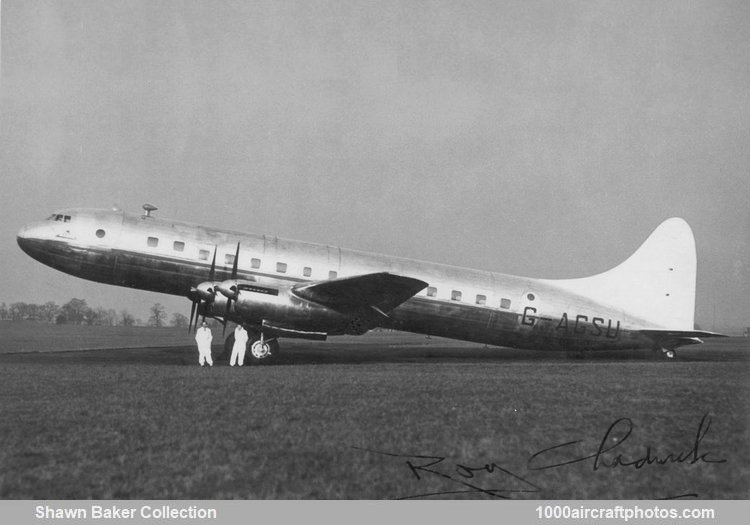
Four months of flight testing followed the maiden flight of the Tudor Mk.II prototype G-AGSU at Woodford Airfield, near Manchester, Lancashire, England, by S.A. Thorn and J.H. Orrell on March 10, 1946. It then went to Boscombe Down for certification trials and the original Rolls-Royce Merlin 102s were changed for the civil equivalent designated Merlin 600 Special. Teething troubles similar to those of the Tudor Mk.I were soon encountered and G-AGSU returned to Woodford in September 1946 for rearward extension of the inner nacelles and the fitting of the enlarged type of fin and rudder.
Increases in structural weight resulting from the stretching processes and subsequent modifications had by this time reduced performance to the point where the Tudor Mk.II could no longer operate from aerodromes east of Calcutta, India or south of Nairobi, Kenia. QANTAS and South African Airways were thus compelled to re-equip with American types and the Tudor Mk.II order was reduced to fifty, at which stage tragedy overtook the prototype G-AGSU which crashed on take off from Woodford on August 23, 1947, due to incorrect assembly of the aileron circuit, an accident which cost the lives of Avro's famous chief designer Roy Chadwick, test pilot Bill Thorn, copilot David Wilson, and flight engineer/radio operator John Webster. Flight engineer Eddie Talbot and designer Stuart Davies were rescued.
In an attempt to recover some of the lost performance, the intended first production Tudor Mk.II G-AGRX (c/n 1261) was completed with four 1,750 hp Bristol Hercules 120 radial engines, and redesignated Tudor Mk.VII it first flown on April 17, 1946, in time for that year's Radlett SBAC Show. When the shortened landing gear was fitted in June 1948 the engine nacelles were tilted to give greater airscrew clearance and the aircraft used for cabin heating tests before delivery to the
MoS in March 1949 as VX199 for use at the Telecommunications Research Establishment at RAF Defford, Worcestershire, England.
Merlin-powered Tudor Mk.II development continued with the second production aircraft G-AGRY (c/n 1262) which the MoS sent to Nairobi for tropical trials serialed as VX202. These proved unsatisfactory and orders were cut back drastically to eighteen. Two Tudors Mk.IIs were made up for experimental work, G-AGRZ (c/n 1263) was loaned to the RAE, Farnborough, G-AGSA (c/n 1264) was loaned to Rolls-Royce Ltd, Hucknall for pressurization, airscrew and engine development. Six were earmarked for completion to British South America Airways (BSAA) requirements as Tudors Mk.Vs to Specification 39/46: G-AKBY (c/n 1417), G-AKBZ (c/n 1418), and G-AKCA (c/n 1419) to G-AKCD (c/n 1422). The remaining ten were earmarked for completion with tricycle landing gear as Avro 711A Traders to Specification 23/48, but this program was shelved.
Powered by four 1,770 hp Rolls-Royce Merlin 621s, the Tudor Mk.Vs were identified by circular instead of square windows and were equipped to carry 44 passengers by day or 36 by night (28 seated, 8 sleeping). Painted in full BSAA livery, they were delivered to the company's engineering base at Langley but did not go into scheduled service. Instead, they were stripped of furnishings and used as tankers on the Berlin Air Lift, the first, G-AKBY, being sold to Airflight Ltd of Blackbushe, which had already acquired Tudor Mk.II G-AGRY. After 85 trips from Wunsdorf to Gatow, each time carrying 9 tons of mixed freight, the latter also became a tanker and in just over a year the immense total of 3,167 tanker sorties was flown by the seven 'large' Tudors.
On their return to England the aircraft were refurnished for passenger work but G-AKBY crashed with a loss of 80 lives due to incorrect loading on March 12, 1950, when approaching to land at Llandow at the end of a charter flight from Dublin, Ireland. G-AKCA flew to Montreal, Canada, in 1952 and appeared for a short time in the colors of Lome Airways as CF-FCY before returning to Stansted, England; while G-AKCC and G-AKCD were disposed of to William Dempster Ltd. and converted to 52-seat layout for London-Johannesburg tourist flights. After G-AKCC was damaged beyond repair when landing at Bovingdon on October 26, 1951, its sister machine went to Stansted, where it was gradually broken up with other Tudor Mk.Vs to provide spares for Air Charter's Super Traders and for Tudor Mk.II G-AGRY which made 13 trooping flights to the Suez Canal Zone for this company as XF537 in September 1953.
Designation Tudor Mk.VI was reserved for six aircraft ordered by the Argentine airline Flota Aerea Mercante Argentina (FAMA) for operation over the South Atlantic with 32-38 day or 22 night passengers. Although airframe numbers were allotted and application made for Cs of A they were not completed. Also derived from the Tudor Mk.II were six aircraft powered by four Rolls-Royce Nene turbojets and equipped with tricycle landing gear. First referred to as the Avro 689 Tudor Mk.IX, this variant was eventually built as the Avro 706 Ashton high-altitude research type.