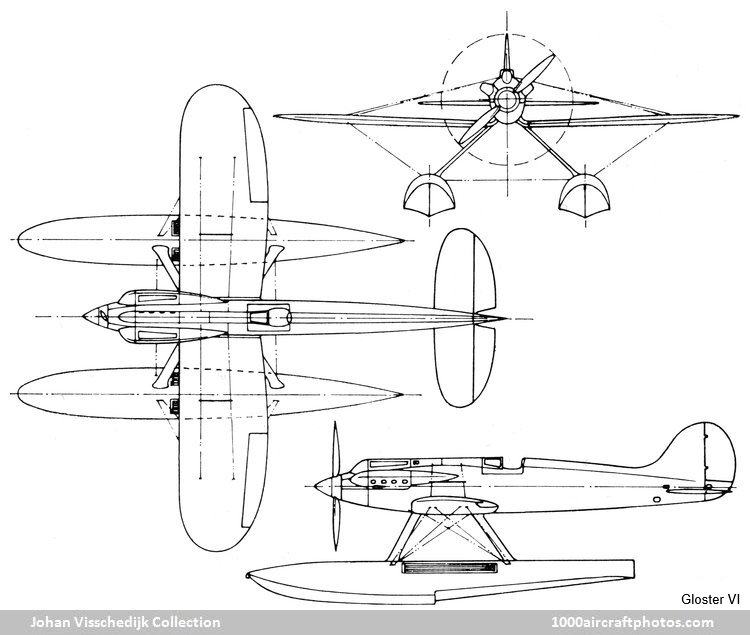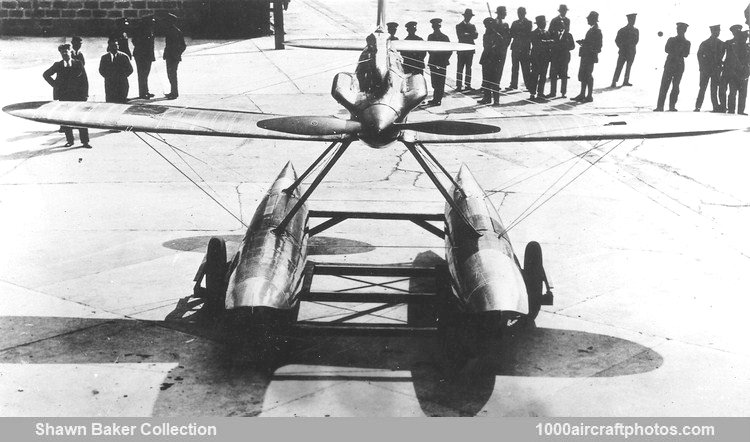
Composite construction was used, consisting of a dural semi-monocoque fuselage with curved integral wing roots to which were attached the 26 ft (7.92 m) span wire-braced wooden mainplanes, which incorporated a straight leading edge coupled with elliptical tips and trailing edge, and with a considerable reduction of chord at the roots. Each of the twin dural floats embodied a main fuel tank amidships, and two sets were constructed, the alternative pair being slightly shorter and of increased cross-section. The alternative pair were found to be more satisfactory in wind tunnel tests.
Every conceivable effort was made to reduce frontal area, and, to this end, flush radiators of very thin section were used, covering about 8% of the wing area. Additional cooling surfaces provided on the floats could be switched to serve either as extra radiators for the engine or for the oil, the main oil coolers being mounted on the fuselage sides aft of the cockpit. The Gloster VI cockpit was fitted initially with a streamlined one-piece windscreen and cover blending into the headrest and with oval side vision panels; an alternative open type of windscreen was provided also.
On completion the two Gloster VIs, serialed N249 and N250, were finished in muted gold overall, together with blue, white and red rudder stripes, a color scheme which suggested the name Golden Arrow. The Gloster VIs arrived at Calshot for trials in mid-August 1929; after preliminary tests it was found necessary to connect the float radiators to the engine water-cooling system, and extra oil coolers were added on the outside of the fuselage just above the wings. Sqn. Ldr. A.H. Orlebar took N249 up at Calshot for its first flight on 25 August and N250 for its initial air test on 31 August, as a result of which further modifications were made to the air intakes to alleviate loss of pressure, to the floats which needed strengthening on the chine line as deflection was experienced with the tanks under load, and to the fuel system.
The powerplant was a 1,320 hp Napier Lion VIID twelve-cylinder supercharged broad-arrow engine, driving a 7 ft 8 in (2-3 m) diameter Gloster two-blade fixed-pitch metal propeller. Continual trouble was experienced with the Lion, which had been over-boosted to try to obtain sufficient power for a small frontal area, and it was found extremely difficult to keep the Lion running without cutting out. Flt Lieut D. D'Arcy A. Greig tried to diagnose the trouble during two flights on September 2 but without success, and Flt Lieut G.H. Stainforth found it impossible to keep the Lion running at full throttle on September 5 while piloting N250. Consequently, both Gloster VIs were withdrawn from the contest.
On September 10, the day after the contest, Stainforth made five runs over the 1.864 mls (3 km) course from Calshot Spit to Agwi Pier in N249 which, although still giving trouble during the turns, flew quite satisfactorily straight and level. This was amply proved by the last four recorded runs during which N249 attained speeds of 351.3 mph (565.35 km), 328.3 mph (528.3 km), 336.2 mph (541.1 km) and 329.3 mph (530.0 km) to give an average speed of 336.3 mph (541.2 kmh). This was later ratified as an Absolute Speed Record, although even this was well beaten only a few hours later by a Supermarine S.6. Just a month afterwards, on November 9, the Gloster VI took part in the Lord Mayor's Show in London.
In 1930 N250 was exhibited in the New and Experimental Types Park at the RAF Display with the Supermarine S.6 and afterwards was returned to Felixstowe where, with a new engine and further modifications to improve the airflow through the carburetor intake, it was used for limited flying, but full power could still not be maintained. N249 was similarly modified with the same results and so, when the High Speed Flight returned to Calshot in May 1931, although this Gloster VI was still on charge as a training aircraft, it was rarely flown."
Span: 26 ft 0 in (7.9 m)
Length: 27 ft 0 in (8.2 m)
Height: 10 ft 9 in (3.2 m)
Wing area: 106 sq.ft (9.8 sq.m)
Max chord: 4 ft 8 in (1.4 m)
Empty weight: 2,284 lb (1,036 kg)
Loaded weight: 3,680 lb (1,669 kg)
Max recorded speed: 351.3 mph (565.35 kmh) at 100 ft (30.4 m)
Take off speed: 110 mph (177 kmh)
Stall speed: 92 mph (148 kmh)