04/30/2014. Remarks by
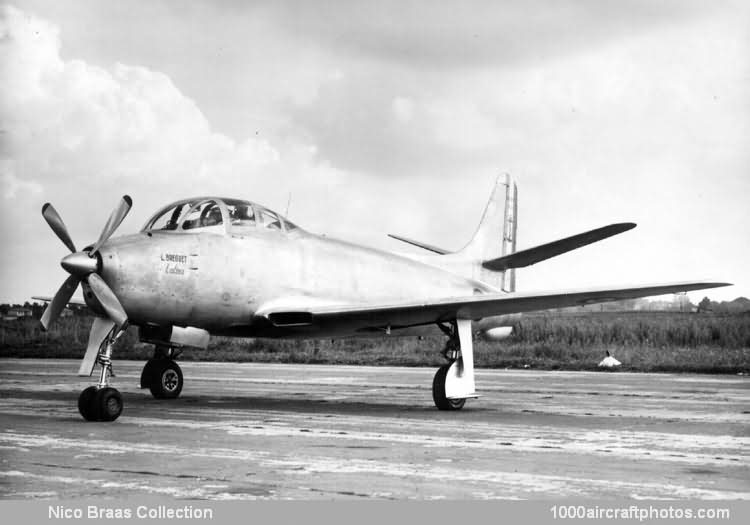
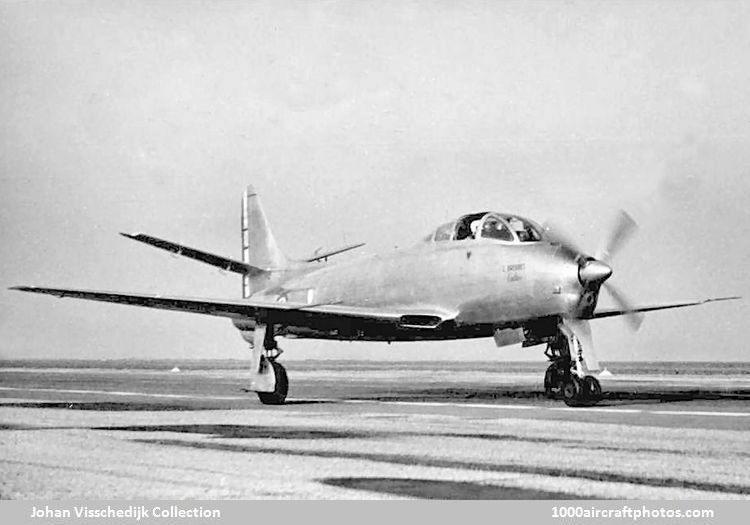
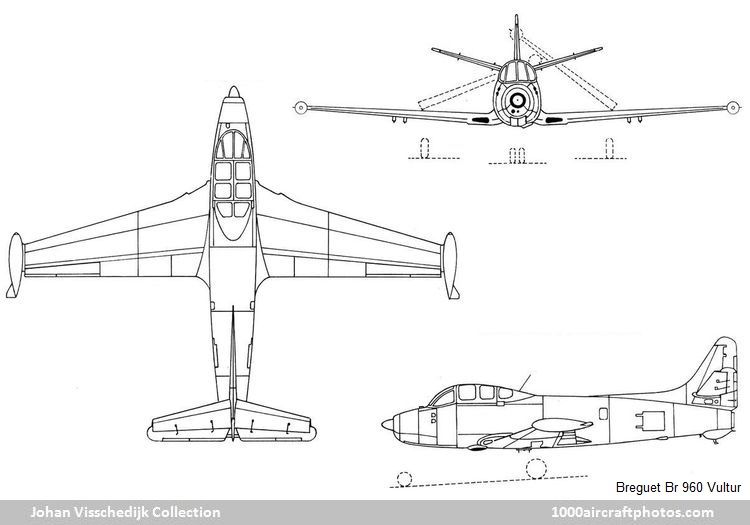
Johan Visschedijk: "The Br 960 was designed as a twin-engined two-seat naval strike aircraft with a composite turbojet-turboprop power plant. It was a low-wing cantilever monoplane with retractable tricycle landing gear and single-ruddered tail unit. The crew of two was seated side-by-side and both members of the crew had ejection seats. The first of two 960 prototypes flew for the first time on August 3, 1951, its power plant consisted of a 4,850 lb (2,200 kg) st Hispano-Suiza (Rolls-Royce) Nene 01 turbojet in the rear fuselage and exhausting at the tail, and a 980 shp Armstrong Siddeley Mamba 1 turboprop in the nose.
Br 960 Vultur (
Johan Visschedijk Collection)
The second prototype, which made its first flight on September 15, 1952, was powered by a 5,000 lb (2,268 kg) st Nene 104 turbojet and an 1,200 shp Mamba 3. This second prototype underwent with success a complete testing program of simulated carrier operations, with catapult-assisted take off and arrested landing, at the Royal Aircraft Establishment, Farnborough, England under the control of the British Ministry of Supply.
However, no orders materialized for the Br 960 in its original form, and the Nene engine of the first prototype was adapted to blow compressed air through injectors to control the boundary layer on the flaps. This program was conducted in cooperation with ONERA (Office National d'Études et de Recherches Aérospatiales, National Office for Aerospace Studies and Research), which undertook part of the wind-tunnel tests.
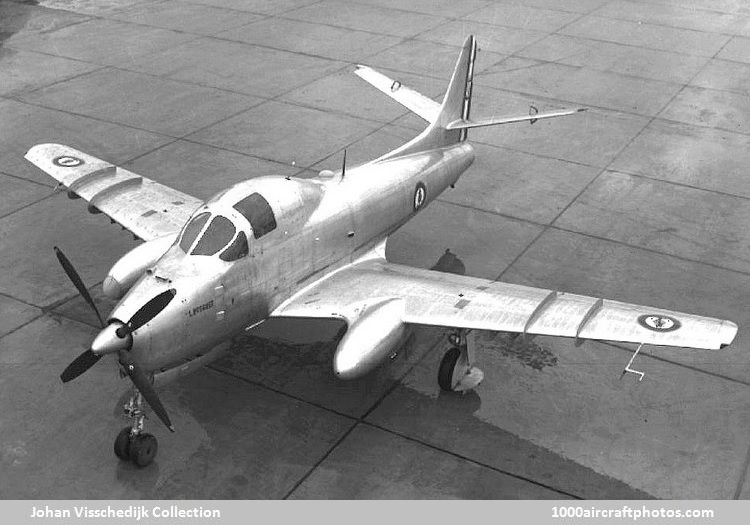
Br 695 Épaulard (
Johan Visschedijk Collection)
02/08/2026. Remarks by
Johan Visschedijk: "For its future anti-submarine warfare (ASW) aircraft, the French Navy, having learned from the unfortunate experiences with the
Bloch 175 and Nord 1402, insisted on the most thorough preliminary testing possible. Breguet offered an adaptation of its second Br 960 prototype, securing a contract at the end of 1953 for the ASW conversion, which would become the prototype for the Br 1050.
In January 1955, the second Vultur, now designated Br 695 Épaulard (Killer Whale), was modified as follows:
The problems posed by the choice of equipment and its installation were carefully studied, despite the limited range of a private aircraft and a portion of its fuel capacity. The landing gear, which retracted into the wing, still occupied the space intended for fuel on the future "Alizé". The Br 965 made its first flight on March 26, 1955, and was primarily intended to check the operation of the added equipment, the dispositions of the crew, and the development of all the equipment specified for the
Br 1050.
With the trials appearing conclusive, the Navy accepted Breguet's final design in August 1955. The Br 965 flew until an accident (landing gear failure) on May 2, 1956. The trials were then well advanced, and the few remaining checks hardly justified a costly overhaul. Its only subsequent use was therefore as a stock of spare parts for the other prototype, which was still flying at the time."