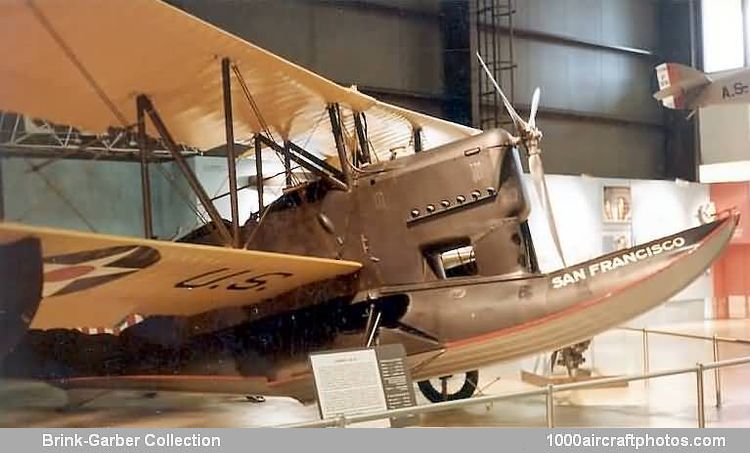
The 22,000 mile (35,400 km) flight began on December 21, 1926, from San Antonio, Texas, USA. The course extended through Mexico, Guatemala, El Salvador, Honduras, Nicaragua, and Costa Rica; across the Panama Canal to Colombia, Ecuador, Peru and Bolivia; down the west coast of South America to Valdivia, Chile; across the Andes Mountains to Bahia Blanca, Argentina; north to Montevideo, Uruguay; up to Paraguay; back down the Paraná River; along the coasts of Argentina, Uruguay, Brazil, the Guianas, and Venezuela; thence through the West Indies and up the coast of the USA to Washington, D.C.
The flight concluded at Bolling Field in Washington, D.C., on May 2, 1927. The fliers were greeted by President Calvin Coolidge and other dignitaries. Within three weeks, however, the historic flight was eclipsed in the public eye by the solo trans-Atlantic flight of Charles A. Lindbergh in the Spirit of St. Louis. After his official welcome in Washington, Lindbergh flew to New York City for ceremonies on June 13, 1927 landing at Mitchel Field, Hempstead, Long Island. There the San Francisco awaited him, with Captain Ira C. Eaker as pilot. Lindbergh was flown to a landing in New York harbor where he boarded a ship that took him to lower Manhattan for his triumphal entry into the city.
The San Francisco was transferred to the Smithsonian Institution by the War Department in December 1927. It was restored by the NASM in 1964-1965, and presently is on display at the USAF museum, on loan from the NASM. View also photo 10561.
The crew of the San Francisco in the Pan-American Goodwill Flight of 1926-1927, were Captain Ira C. Eaker, pilot, and First Lieutenant Muir S. Fairchild, copilot. Both Eaker and Fairchild had distinguished careers reaching the rank of general, i.e.
Ira C. Eaker. In January 1942, he was assigned to organize the VIII Bomber Command in England and to understudy the British system of bomber operations; then in December 1942, he assumed command of the USAAF's Eighth Air Force in England. Later, he became commanding general of all USAAF units in the UK. In January 1944, he was named air commander-in-chief of the Mediterranean Allied Air Forces, having under his command the USAAF's Twelfth and Fifteenth Air Forces and the RAF's Desert and Balkan Air Forces. On April 30, 1945, General Eaker was named deputy commander of the USAAF and chief of the Air Staff. He retired August 31, 1947, and was promoted to lieutenant general on the retired list June 29, 1948. A special act of Congress promoted him to the rank of general in 1985.
Muir S. Fairchild. In March 1942 he became director of military requirements and was promoted to major general in August. In November he became a member of the Joint Strategic Survey Committee of the Joint Chiefs of Staff. In January 1946 he was named commandant of Air University at Maxwell Field, Montgomery, Alabama, USA, with promotion to lieutenant general. On May 27, 1948 he became vice chief of staff of the USAF, with the rank of four-star general. General Fairchild died at Fort Myer, Virginia, USA, March 17, 1950 while on active duty as vice chief of staff.
