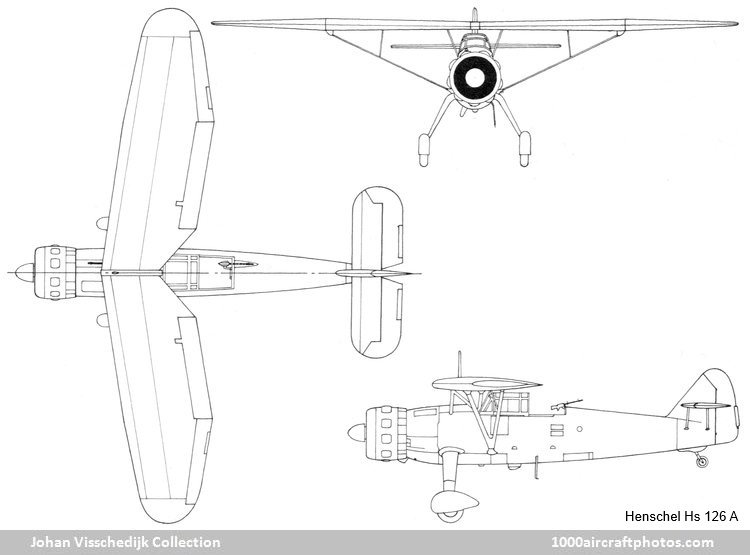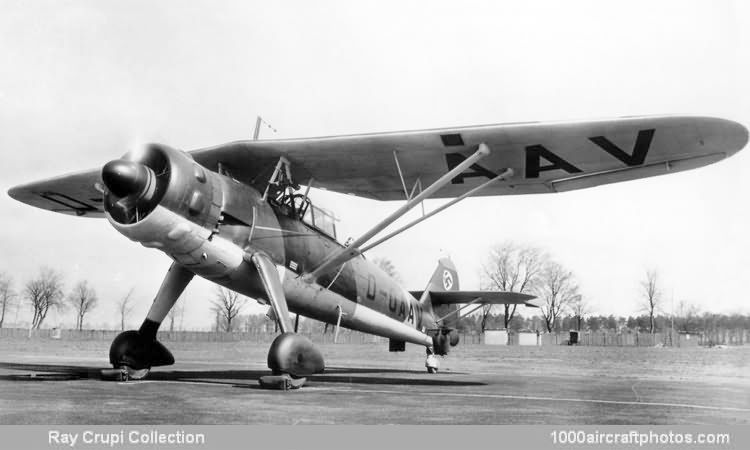
The following prototype Hs 126 V2 was fitted with the originally planned 850 hp Bramo 323A-1 Fafnir nine-cylinder air-cooled radial engine. Also it differed from the V1 in having an exhaust driven two-stage supercharger, an enlarged rudder, and extra tail plane braces. The Hs 126 V3 further had a redesigned tail plane and landing gear.
Ten pre-production Hs 126 A-0 similar to the Hs 126 V3 were built and delivered before the end of 1937. Their success in operational use speeded the production and already in early 1938 the first Hs 126 A-1 were delivered to the Luftwaffe. The A-1 was fitted with the 880 hp BMW 132Dc nine-cylinder air cooled direct injection radial engine as the intended Bramo 323 Fafnir was restricted. In late 1939 the Hs 126 B-1 was in production fitted with the Bramo 323 Fafnir in the 850 hp A-1 or Q-1, or in the 900 hp A-2 or Q-2 engine variants; and with improved equipment.
The armament consisted of two on the starboard side mounted 0.312 in (7.92 mm) machine guns: a fixed forward firing MG 17 and a flexible MG 15 in the gunner/observer position, this gun had a recess in fuselage when not in use. Further a bomb of 110 lb (50 kg) could be fitted below the port fuselage; an equipment bay could hold a bomb load of ten 22 lb (10 kg) bombs, or a Zeiss Rb topographic camera, or a smoke-screen apparatus.
The parasol-winged monoplane was of all-metal, stressed skin construction, with fabric covered control surfaces. The tandem-seated crew had covered a cockpit with a forward sliding hood over the gunner/observer position. The aircraft had excellent slow speed flight and short field characteristics; for rough muddy field operations often the wheel spats were removed. The aircraft was well equipped, this also allowing night operations.
The Condor Legion used 6 Hs 126 A-1 in Spain, after the operations they were handed over to the Nationalist AF. Greece received 16 Hs 126 A-1 and used them against the Italian and ironically the German forces during their campaigns against Greece. A total of 510 Hs 126 have been built.
The Hs 126 was in German use from 1938 to 1945, until 1942 as the standard tactical reconnaissance aircraft seeing action on all fronts as it equipped 80% of its type-units. After than it was used as glider-tug and it played a role in night ground-attacks against partisans.
The data below is referring to the Henschel Hs 126 B-1
Span: 47 ft 6.9 in (14.50 m)
Length: 35 ft 7.2 in (10.85 m)
Height: 12 ft 3.6 in (3.75 m)
Wing area: 340 sq.ft (31.6 sq.m)
Empty weight: 4,475 lb (2,030 kg)
Loaded weight: 7,209 lb (3,270 kg)
Max speed: 221 mph (355 km/h) at 9,843 ft (3,000 m)
Cruise speed: _ mph (_ kmh) at _ ft (_ m)
Climb: 1,873 ft (571 m)/min
Ceiling: 27,018 ft (8,235 m)
Range: 438 mls (705 km)