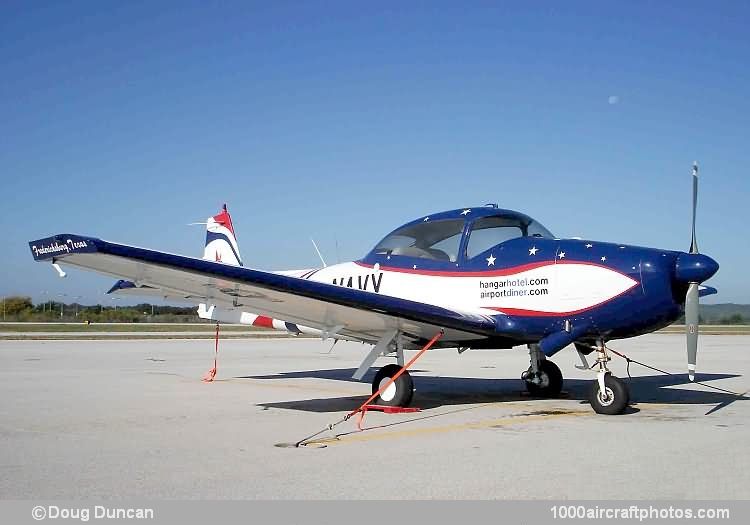
10/31/2008. Remarks by Doug Duncan: "The photo shows off the Navion's clean, efficient lines, which are very reminiscent of its predecessor, the venerable P-51 Mustang, right up to the sliding canopy. Because of this, when the Navion first came out, people often referred to it as "Everyman's Mustang", which would have been even more true had it been produced in taildragger form, as originally planned. I can just imagine how that would've looked.
North American had hoped to corner the light military trainer market with the Navion, but it lost out on that to the Beechcraft T-34 Mentor, which really looked -- and probably felt -- more like a true military plane, with all due respect to the Navion. But don't worry, though, as the Navion did eventually end up in military service as the L-17. According to Twin Navion.com:
"In 1952 the USAF deployed L-17s to the Orient in the first wave of the Korean War. The first L-17s actually took off from the aircraft carriers USS Sicily and USS Badoeng Strait. Once in Korea L-17 pilots, with their RCA radios, were able to relay communications from the common foot soldier to the warplanes of the USAF and USN. In many cases these were requests for air strikes - giving birth to Forward Air Control (FAC). Several reports were even made of Communist soldiers confusing L-17s with the similar looking F-51D Mustang and either sought cover from passing Navions or surrendered to the unarmed planes."
The pictured aircraft was produced in 1946, the design was sold to Ryan in 1948."