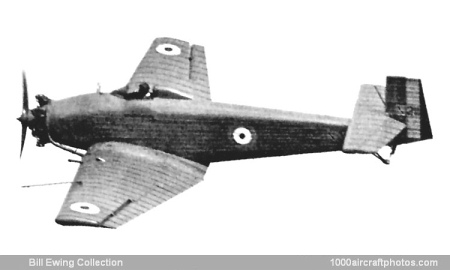
Intended to use either wheel or float landing gear, and suitable for launching from a catapult, the Vireo was powered by a 230 hp supercharged Armstrong Siddeley Lynx IV seven-cylinder air-cooled radial engine and had provision for two wing-mounted 0.303 in (7.7 mm) machine guns firing outside the propeller disc.
The structural design of the Vireo followed closely that of the Type 121, with the airframe virtually entirely covered by corrugated metal skinning. Flown early in March 1928 - flight testing having been delayed by extensive aerodynamic and structural tests undertaken at the Royal Aircraft Establishment - the Vireo was evaluated at Martlesham Heath in April and deck trials then took place aboard HMS Furious on July 12.
The Vireo was fitted with a twin-float landing gear (site files), but, in the event, seaplane trials that were to have taken place at the MAEE, Felixstowe, were not proceeded with. The speed performance of the Vireo was inevitably poor owing to the combination of low engine power and high drag resulting from the corrugated surfaces, and it suffered extremely unpleasant stalling characteristics. In consequence, development was terminated.