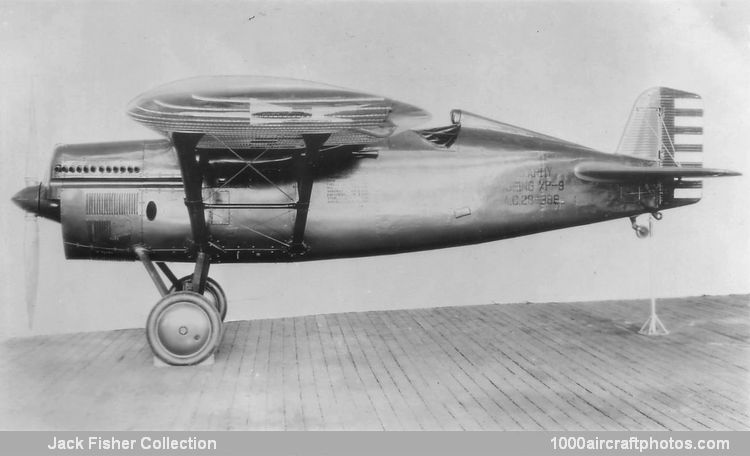
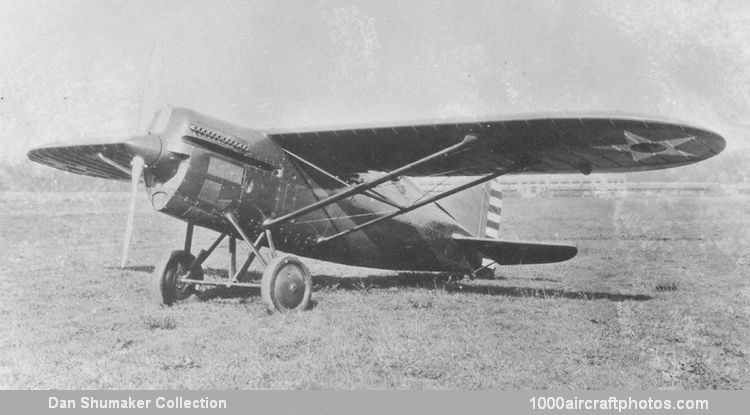
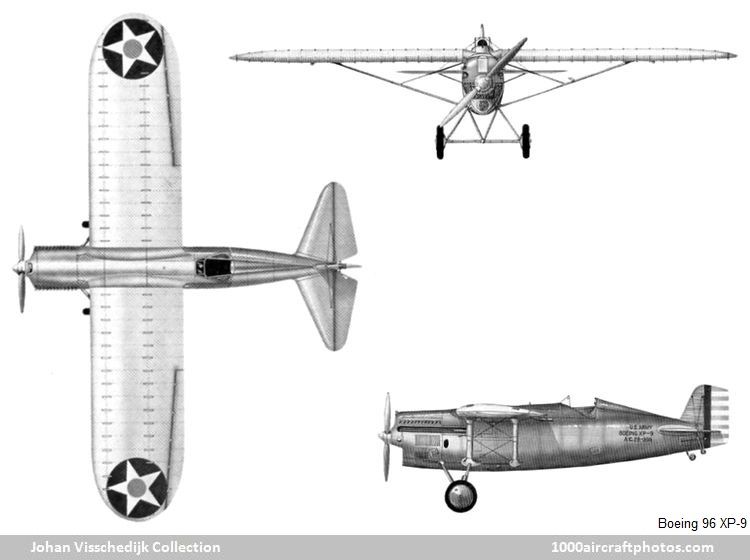
01/31/2010. Remarks by Johan Visschedijk: "The Model 96 was a fighter designed to Army Specification X-1623A on May 24, 1928, and designated XP-9 by the Army when a contract for its design and construction was signed with Boeing on May 29,1928. The XP-9 was the first Boeing monoplane to start through the factory, but various delays postponed its scheduled delivery date from April 1929, to September 1930, so it was not the first to fly, having been beaten into the air by the new Model 200 Monomail and the Model 202 and 205 fighters.
The construction of the XP-9 was entirely new to Boeing practice, and both the 200 and the 202/205 designs drew heavily on it. The fuselage was the most advanced feature, using a semi-monocoque structure of sheet dural over metal formers for that portion aft of the rear landing gear struts and welded steel tubing from that point forward to the engine. The original tail surfaces were identical to those of the P-12/F4B, and the conventional two-spar wing used metal framework with fabric covering. The general proportions were those of the P-12/F4B cut down to a high-wing monoplane.
The XP-9 was not test flown in Seattle as was customary, but flew on November 18, 1930, after delivery by rail to the Army Test Center at Wright Field, Ohio.