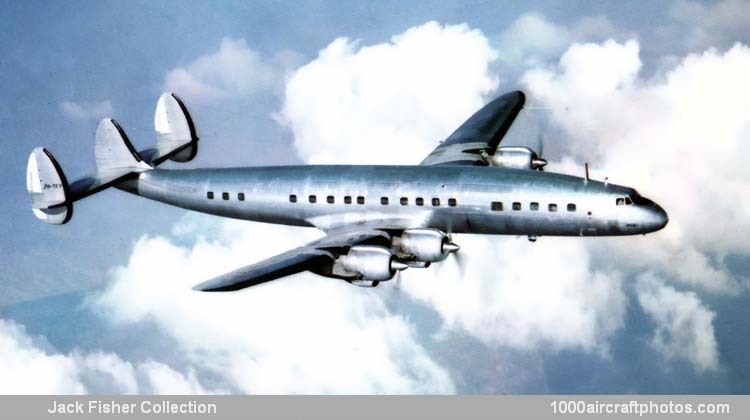
05/31/2010. Johan Visschedijk: "First commercial transport certificated with Turbo-Compound engines, the Model 1049C was developed to correct the basic shortcomings of the original Model 1049, insufficient power resulting in performance lower than that of the Douglas DC-6B, by taking advantage of the new power plant developed by the Wright Aeronautical Division of Curtiss-Wright.
Adding to the basic Double Cyclone engine three 'blow-down' turbines, which converted the heat energy of exhaust gases into additional power, the Turbo-Cyclone offered a 20% reduction in fuel consumption. In its 872TC-18DA-1 version as fitted to the Model 1049C, this engine was rated at 3,250 hp for take off and markedly improved performance. Take off gross weight and maximum landing weight were respectively increased to 133,000 lb (60,328 kg) and 110,000 lb (49,895 kg).
The first Turbo-Cyclone powered Super Constellation, the pictured PH-TFP, began flight trials on 17 February, 1953, three months before the similarly-powered Douglas DC-7. Lockheed produced a total of 48 Model 1049Cs, for delivery between June 1953 and June 1954 to Air France (ten), Air-India (two), Eastern (sixteen), KLM (nine), PIA (three), Qantas (three), and TCA (five).
PH-TFP was registered in the Netherlands on December 20, 1953, was reregistered as PH-LKP on March 8, 1954 and in 1956 the designation was altered to a Model 1049E. On June 22, 1965, the aircraft was deregistered as "scrapped and sold in parts"."