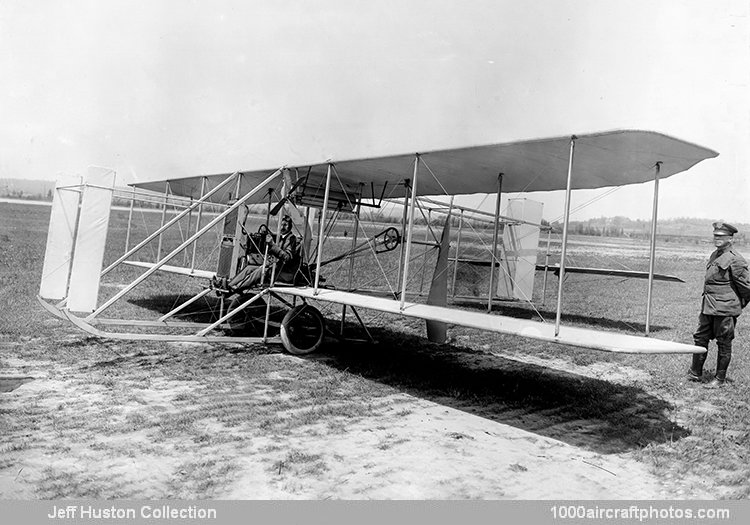
02/08/2026. Remarks by Kees Kort: "In 1912 the US Army Signal Corps (USASC) Aeronautical Division asked the Wright brothers firm, The Wright & Co., to develop a more powerful development of the model B. It was to be used as a long range scouting airplane. The Wrights responded with the model C which was powered by a six-cylinder water-cooled Wright engine rated at 60 to 75 hp. Installing this heavier engine meant several modifications. One visible one is the larger radiator which is mounted upright between the wings to the left side of the pilot. Several modifications had nothing to do with the needed strengthening of the machine. Examples are the dual-steering and the vertically placed stabilizers fitted on the skids. This was a new invention of the Wrights for automatic stability.
In all the USASC acquired six Wright model C machines, serial numbers 10 to 14 and 16. The operational use of the machines was a disaster as four of them crashed, killing three pilots. The Wrights and the USASC had opposing opinions about these crashes. The Wrights thought it was pilot error while the USASC thought it was a construction error. The opposing views seem not to have been resolved, but in beginning 1914 all pusher airplanes (Wright and Curtiss) were banned from the USASC.
However, by 1918 at least one aircraft had survived at Dayton, Ohio. Although not his property, Orville Wright used it as his personal aircraft, he is pictured at the controls."