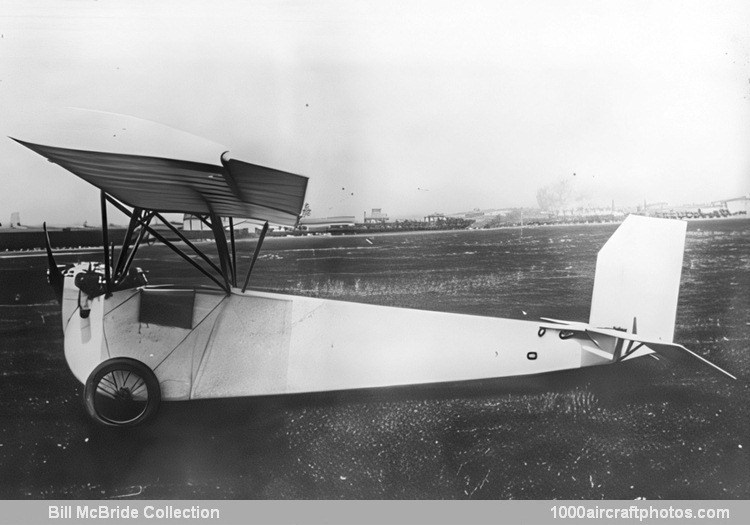
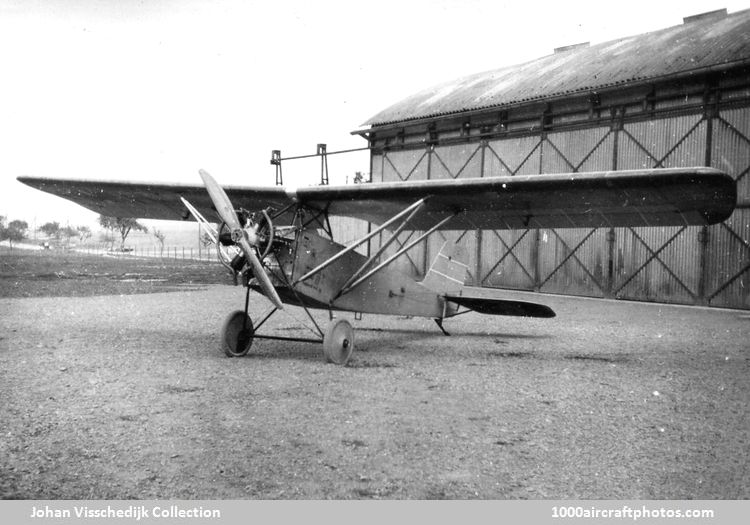
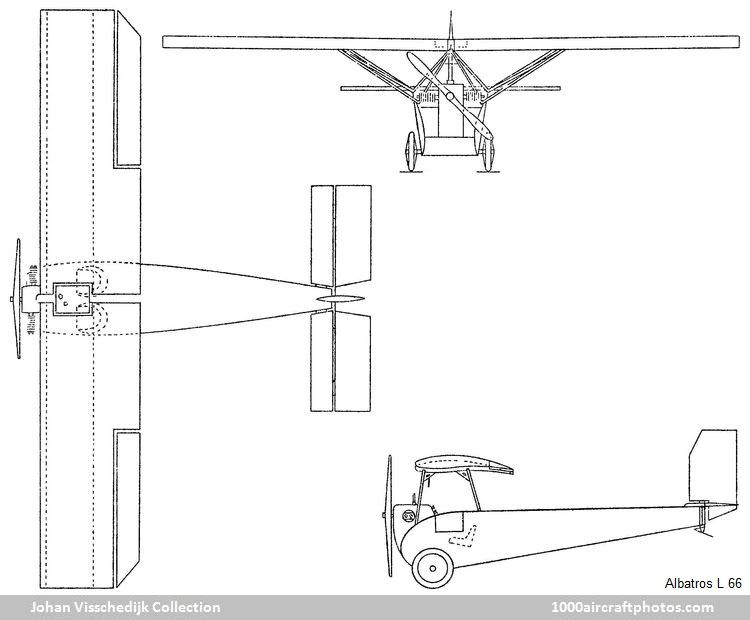
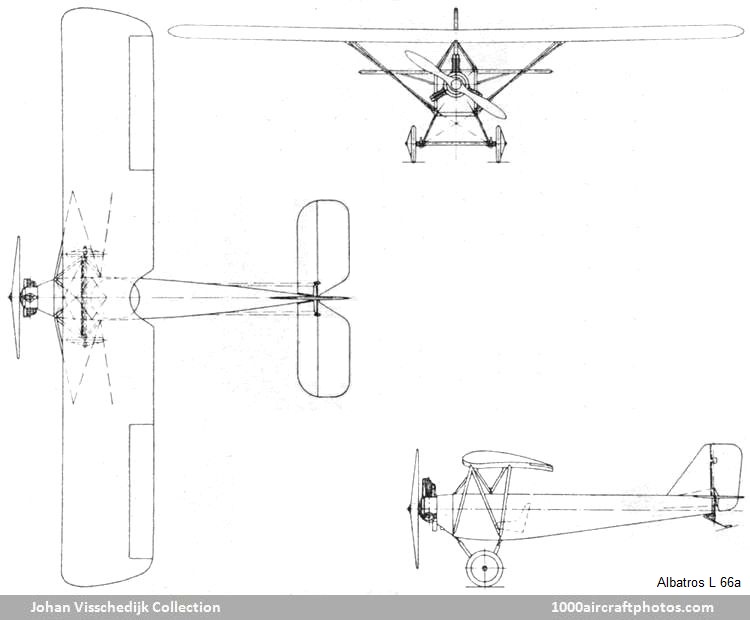
02/08/2026. Remarks by Johan Visschedijk: "Built in 1924, the small two-seat Albatros L 66 was intended as a low cost, easy maintenance sport and training aircraft.
The L 66 was chiefly distinct from all previous Albatros aircraft, which had constructed fuselages with wood frames and plywood covering, by its fuselage which had a welded steel tube longeron and strut framework, braced by steel wire. The cantilever parasol monoplane had a wing with a thick Gottingen 430 type profile, which had a significant dihedral angle. It was of common wood construction, mounted on a rather complicated set of struts. Both fuselage and wings were covered with fabric. The empennage was simple in shape and action as there were no fixed surfaces only an all-moving rudder and elevator. All control surfaces, ailerons, rudder and elevator, were of steel tubing construction and balanced.
The landing gear was a simple axle with two wheels slung inside the fuselage, through the sides of which the axle projected, sitting the L 66 close to the ground. The tail skid was interconnected to the rudder shaft, to enable the aircraft to be easily steered when taxying at low speed. The two-seat aircraft had an open cockpit with side-by-side seatings.
The power plant of the pictured aircraft was a 30 hp Haacke four-stroke two-cylinder horizontal-opposed air-cooled engine, driving a two-blade propeller. The 8.72 gal (33 l) fuel tank was mounted in the wing center section at the center of gravity.
Particular emphasis was placed on road transportability. The two wings and the fuselage were designed so that they could be folded onto the fuselage after the elevators on the rudder had been folded up. The folded aircraft had a width of 3 ft 11.25 in (1.2 m), a length of ca. 17 ft 8.5 in (5.4 m), and a height of ca. 7 ft 2.5 in (2.2 m).
Off the L 66 only four aircraft were produced, registered D-912 (c/n unknown), D-1270 (c/n 10049), D-1340 (c/n 10046), and D-1402 (c/n 10048).