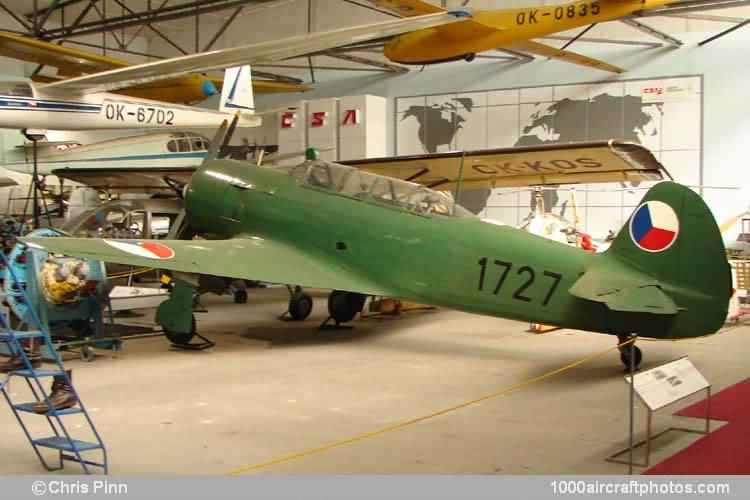
09/15/2020. Remarks by Johan Visschedijk: "As an advanced trainer Czechoslovakia selected in 1952 the Yakovlev Yak-11 to replace the Avia C-2 (license-built Arado Ar-96). A license was obtained to manufacture the Yak-11 locally, and production was started at the Let factory in Kunovice. Bearing the factory designation Le-10, they became commonly known by the Czechoslovakian AF designations C-11 and C-11U (C = cvičny - trainer). The ASh-21 engine was also license-built as the M-21. The Czechoslovak-built aircraft differed from their Soviet prototype in having additional antennas under the fuselage. They were all fitted with a single ShKAS machine gun.
The first Czechoslovakian example flew on October 29, 1953, and eventually 704 C-11s and three C-11Us (with a tri-gear landing gear) were built up to 1956. The C-11 was produced not only for domestic use, but also for export, in particular to some countries in the Middle East. After the Czechoslovakian AF withdrew the C-11 from service, many of them handed over to the aero Clubs, others, alike C-11s withdrawn from service by other air forces, received a new lease of life as 'warbirds' or as racing machines. However, many of these Let Le-10 C-11 aircraft were registered as a Yakovlev Yak-11.
The pictured aircraft was handed over to the Letecké Muzeum in September 1967, after it had been restored by air force personnel.