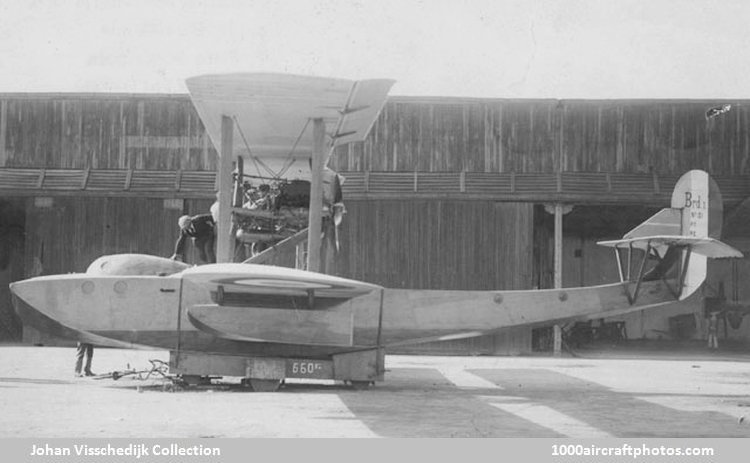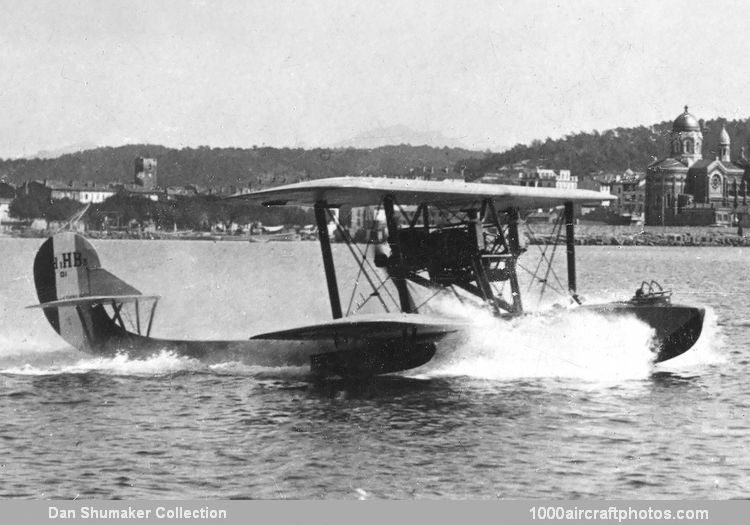
As Blanchard lacked his own manufacturing facilities, the Blanchard Brd.1 prototype was built at the Blériot aircraft factory. The prototype underwent buoyancy tests on the Seine River before making its maiden flight in 1922. The trials were successful, and the French Navy ordered the production of 24 examples, intended to equip Escadrille 5RI at Saint-Raphaël. Blériot also built the 24 production aircraft according the specification HB.3 issued by the Service technique de l'aéronautique (STAé, Aeronautical Technical Service). The first units were delivered in 1923, however, due to their poor operational performance, the service life of the Brd.1s was short, with the final aircraft being retired in 1926.
The Blanchard Brd.1 was a central-hull flying boat with balancing floats, twin engines and a biplane wing configuration. The hull, equipped with a single-step bottom, was made entirely of wood. The three crew members were seated in open positions.
The single-bay sesquiplane was made with a mixed structure and covered with fabric. The upper wing was connected to the lower wing with trusses, the upper wing mounted high as a parasol and the lower wing above the hull. The aircraft was powered by two 260 hp Hispano-Suiza 8Fe eight-cylinder water-cooled V-engines. The engines were positioned side-by-side on engine mounts supported by N-shaped steel truss, and drove two-bladed propellers in pusher configuration.
The armament was based on two 0.303 in (7.7 mm) machine guns on flexible mounts, one in the bow and one in the center, both in open positions. Two 220 lb (100 kg) and two 110 lb (50 kg) bombs were divided on four underwing racks.
Span: 62 ft 4.00 in (19.00 m)
Length: 45 ft 5.25 in (13.85 m)
Height: 13 ft 5.40 in (4.10 m)
Wing area: 915 sq.ft (85 sq.m)
Empty weight: 5,434 lb (2,465 kg)
Loaded weight: 8,664 lb (3,930 kg)
Max speed: 104.30 mph (168 kmh)
Cruise speed: 77.67 mph (125 kmh)
Service ceiling: 11,483 ft (3,500 m)
Range: 155 mls (250 km)