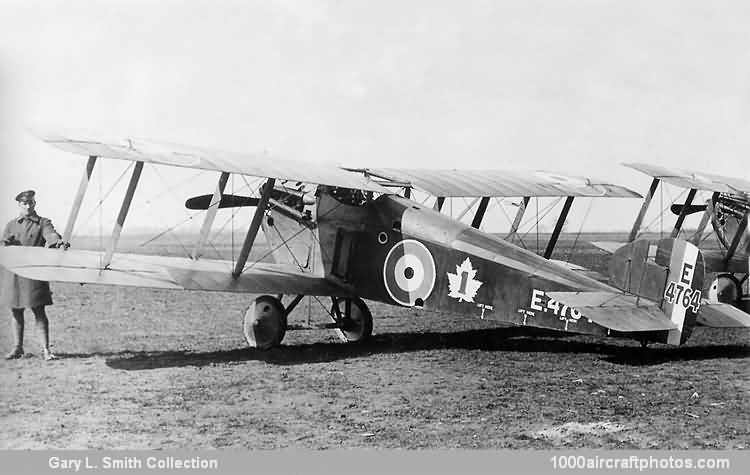
Primarily of fabric-covered wire-braced wooden construction with an upper centre section of steel tube, the Dolphin was powered by a 200 hp Hispano-Suiza geared eight-cylinder water-cooled engine in its initial production form.
Armament consisted of two fixed and synchronized 0.303 in (7.7 mm) machineguns and either one or two machineguns of similar caliber mounted over the wing centre section and movable, but usually firing forwards and upwards. The prototype was flown in late May 1917, the first production contract was placed in the following month, on June 29, and quantity deliveries to the RFC began late in the year.
The first Dolphin squadron was deployed to France in February 1918, and the decision was taken to license-build a version for the USAAS in France. This, the Dolphin Mk.II powered by a 300 hp Hispano-Suiza engine, was to be manufactured by the SACA (Societe Anonyme des Constructions Aeronautiques) and the USAAS anticipated taking delivery of 2,194 by mid 1919. In the event, only a few Dolphin Mk lIs were completed before the Armistice prompted cancellation of all contracts.
Difficulties with the reduction gear of the original 200 hp engine led to the conversion of many to direct drive, aircraft fitted with the modified power plant being designated Dolphin Mk.III and some engines having their compression ratio raised to boost output to 220 hp. Production of the Dolphin totaled 1,532 aircraft, of which all but 121 were built during 1918. Both Dolphin Mk.I and Mk.III were finally withdrawn from RAF service mid 1919. The following data relate to the Dolphin Mk.III.
Span: 32 ft 6 in (9.90 m)
Length: 22 ft 3 in (6.78 m)
Height: 8 ft 6 in (2.59 m)
Wing area: 263.25 sq.ft (24.46 sq.m)
Weight empty: 1,466 lb (665 kg)
Loaded weight: 2,000 lb (907 kg)
Max speed: 128 mph (206 kmh) at 6,500 ft (1,980 m)
Climb: to 6,500 ft (1,980 m) 6 min 20 sec
Canadian Air Force 1918 – 1920.
On August 5, 1918 the British Air Ministry decided to form two Canadian Squadrons, one a fighter and the other a day bomber squadron. The Canadian Government approved the formation of the Canadian Air Force on September 19, 1918 comprising these two squadrons. Lieutenant-Colonel W.A. Bishop, Canada first airman to be awarded the Victoria Cross and the British Empires leading ace was the CAF's first commander.
On November 20, 1918, nine days after the Armistice, No. 1 (F) Squadron was formed at Upper Heyford with Sopwith Dolphins, later converted to the S.E. 5a, and on November 25, 1918 No. 2 (B) Squadron was formed with Airco D.H.9 bombers.
However, on June 19, 1919 the Canadian Government decided not to form a permanent peacetime air force and orders were sent to cease all flying operations and all equipment belonging to Canada was to dismantled and shipped to Canada. No. 1 Squadron was disbanded on January 29, 1920 and No. 2 on February 5, 1920.
The pictured Hispano-Suiza powered E4764 is from a production batch ordered from the Sopwith company by the war office on March 13, 1918, and shows the insignia of No.1 Squadron, Canadian Air Force.
