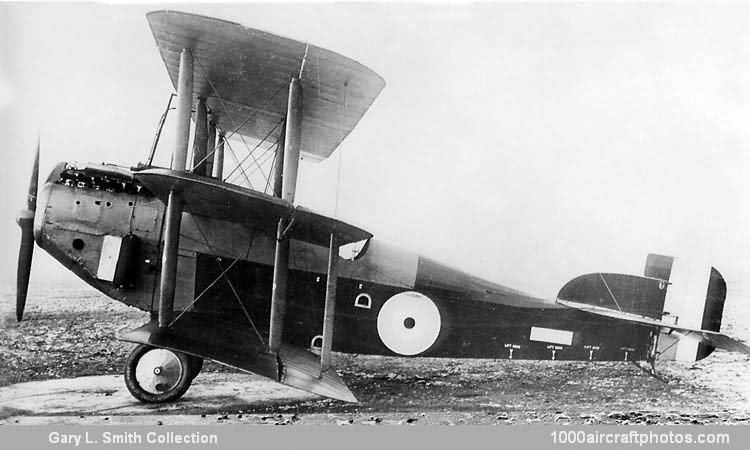
03/31/2009. Remarks by Johan Visschedijk: "The private venture Rhino experimental bomber triplane could carry a bomb load of 450 lb (204 kg) stowed beneath the pilots seat, while at the gunner's position a Lewis machine gun was fitted. The Rhino was powered by a 230 hp B.H.P. (Beardmore-Halford-Pullinger) six-cylinder liquid-cooled engine and flew for the first time in late October 1917.
The B.H.P. in the engine designation stood for Beardmore-Halford-Pullinger, the original design was done by Captain (later Major) F.B. Halford, in collaboration with Sir William Beardmore and T.C. Pullinger. The B.H.P. engines were produced in quantity by The Galloway Engine Co., Ltd. of Dumfries, and by The Siddeley-Deasy Motor Co., Ltd. of Coventry.
The two Rhino's built were serialed X7 and X8 in the Licensed Series."