06/23/2025. Remarks by
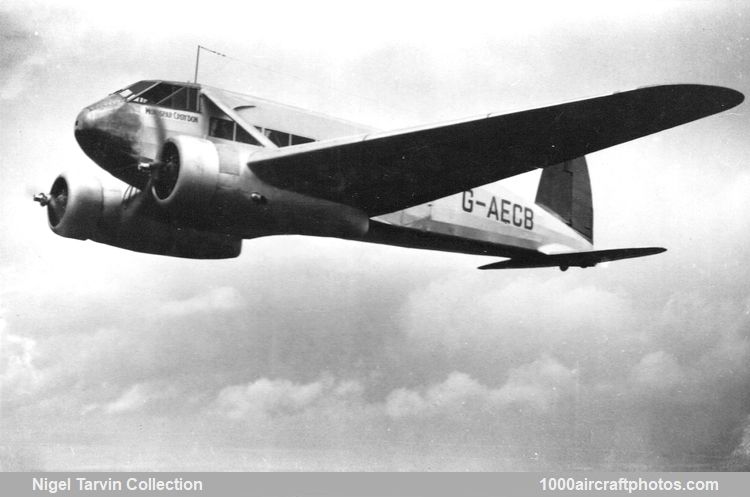
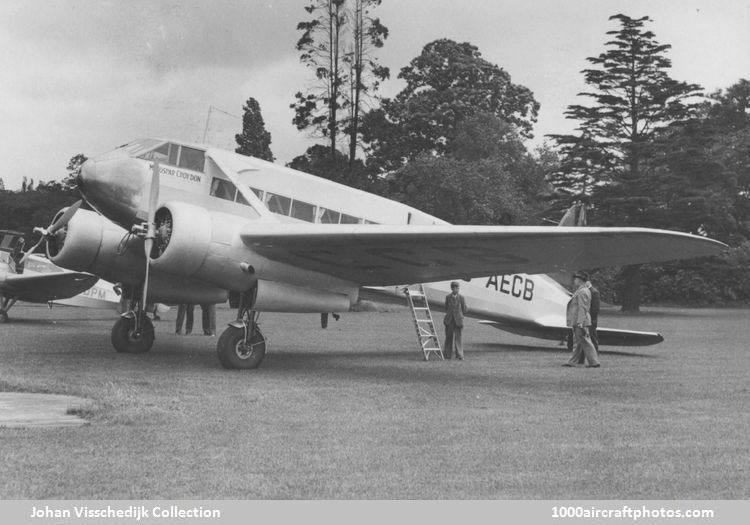
Johan Visschedijk: "General Aircraft Limited designed and built the Monospar ST.18 light transport at Hanworth Aerodrome, England in 1935.
Of conventional construction with metal frame construction and fabric covering, the monoplane had much larger dimensions and heavier engines as earlier Monospars, like the
ST.4,
ST.12 and
ST.25, hence the monospar wing of the Monospar ST.18 was not cantilever, but was fitted with bracing struts. It had a tailwheel landing gear, with a hydraulically retractable main gear. It was powered by two 450 hp Pratt & Whitney R-985-SB-9 Wasp Junior nine-cylinder, air-cooled radial engines. The aircraft had a crew of two, a cabin for ten passengers, a toilet and a baggage compartment.
Under the General Aircraft '
Class B' marking T-22, the Monospar ST.18 was first flown by the Director and General Manager of the company, Flying Officer Harry M. Schofield, at Hanworth Aerodrome on November 16, 1935. February 14, 1936, the aircraft was registered to the company as G-AECB (
CofR 6716), while it received its
CofA 5543 on June 16, 1936. Despite its impressive performance it did not attract any orders. It was decided a fast flight to Australia and return would promote the aircraft. Major Claud Ronald Anson of Crondall, Hampshire, agreed to purchase the prototype and have his personal pilot Harold "Tim" Wood make the Australian tour.
(
Johan Visschedijk Collection)
On July 2, 1936, the Monospar ST.18 was sold and registered to Major Anson (CofR 7162), and was named Monospar Croydon. July 7, with Major Anson and The Lord of Sempill aboard, Wood departed Hanworth for Australia but encountered problems at Vienna, Austria, returning to Hanworth the following day.
Three weeks later, July 30, the Monospar Croydon departed from Croydon for Australia, crewed by Harold Wood (pilot), Lord Sempill (second pilot), L. Davies (flight engineer) and Charles.P.R. Gilroy (radio operator). A significant delay was caused by hard landing at Karachi, Pakistan, Lord Sempill left the flight and General Aircraft Ltd's Chief-Designer Frederick Crocombe joined the crew. After repairs the aircraft finally arrived in Darwin, Northern Territory, Australia in September, subsequently it was demonstrated on several locations, including Sydney and Melbourne.
On October 7, 1936, the Monospar ST.18 and crew left Darwin for Koepang, Timor (515 mls, 830 km WNW) for the return flight to England. The crew were planning to reach London in five days, however, strayed badly off course over the Timor Sea due to poor radio signals and compass error, and failed to make landfall.
With just 30 minutes fuel remaining Harold Wood landed the aircraft safely on its wheels on a coral reef (Seringapatam Reef) exposed by a neap tide, although the tailwheel assembly was damaged by rocks. The Seringapatam Reef is situated 600 mls (966 km) west of Darwin. The crew was taken off the reef by a fishing boat nearby before the tide covered the reef, and were later transferred to a passing ship, the SS Nimoda bound for Durban, South Africa. The scarcely damaged sole Monospar ST.18 had to be abandoned and G-AECB was deregistered in December 1936 as withdrawn from use.
On February 23, 1948, Captain Cyril Kleinig of MacRobertson Miller Airlines, operating a DC-3 on a charter flight carrying Timorese pearl divers from Koepang to Broome in Western Australia, spotted the tattered cover remains of G-AECB which appeared to be still in one piece.