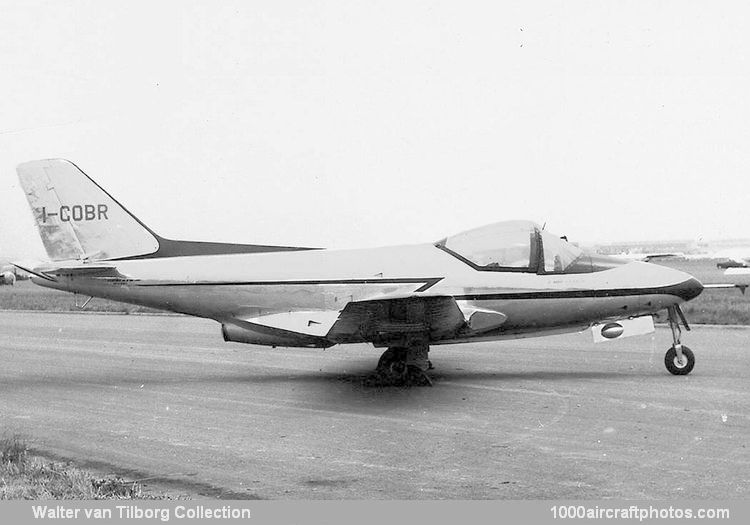
Registered I-COBR the Cobra 400 was first flown on November 16, 1960, it was presented at the Paris Air Show in June 1961. The flight tests and the flights for obtaining an airworthiness certificate were made by Pierre Bonneau of Expertavia. In January 1963 reports of these tests were submitted, by that time the aircraft had made 92 flights for a total of 82 hr and 10 min.
In August 1965 the aircraft was destroyed when it crashed into the Alps on its return to Italy after participating in an air show in France. Subsequently further development was halted.
Wings: Cantilever low-wing monoplane. NACA 643216 wing section. Single-spar wings, ailerons and flaps have wood structure with plywood covering and outer skin of thin aluminum sheet bonded to the plywood. Flaps were actuated hydraulically.
Fuselage: Wood semi-monocoque structure with plywood covering and outer skin of thin aluminum sheet bonded to the plywood. Hydraulically-operated ventral air-brake of metal construction.
Tail unit: Cantilever wood structure with plywood covering and outer skin of thin aluminum sheet bonded to the plywood. Electrically- operated trim-tab in starboard elevator.
Landing gear: Retractable tricycle type, hydraulic retraction. Magnaghi oleo-pneumatic shock-absorbers. Magnaghi 5.00 x 5 nose-wheel and Cleveland 6.00 x 6 main wheels. Cleveland hydraulic disc brakes.
Power plant: One 882 lb (400 kg) st. Turboméca Marboré II turbojet engine. Fuel in two tanks in wings, and one tank in fuselage.
Accommodation: Two seats side-by-side in enclosed cabin. Rearward-sliding canopy was jettisonable in flight.
Electronics and Equipment: Blind-flying instruments, Narco Mk.V VHF and ADF-29 were standard equipment."
Span: 28 ft 6.52 in (8.70 m)
Length: 26 ft 6.90 in (8.10 m)
Height: 9 ft 2.24 in (2.80 m)
Wing area: 131.5 sq ft (11.70 sq.m)
Wing chord, at root: 5 ft 3 in (1.62 m)
Wing chord, at tip: 3 ft 1 in (0.95 m)
Wing incidence: 4°
Wing aspect ratio: 6.5
Wing thickness/chord ratio: 16.5%
Wing dihedral: 6°
Ailerons area (total): 10.98 sq ft (1.02 sq.m)
Flaps area (total): 15.50 sq ft (1.44 sq.m)
Fin area: 9.50 sq ft (0.88 sq.m)
Rudder area: 5·27 sq ft (0.49 sq.m)
Tailplane span: 10 ft 5 in (3.15 m)
Wheel track: 9 ft 1 in (2.77 m)
Wheel base: 10 ft 7 in (3.23 m)
Empty weight: 2,425 lb (1,100 kg)
Max take off weight: 3,748 lb (1,700 kg)
Max wing loading: 29.7 lb/sq ft (145 kg/sq m)
Max power loading: 9.37 lb/lb (4.25 kg/kg)
Fuel capacity: 136 gal (515 l)
Max level speed: 360 mph (580 kmh) at 13,100 ft (4,000 m)
Max dive speed: 447 mph (720 kmh)
Econ cruise speed: 236 mph (380 kmh) at 13,100 ft (4,000 m)
Max cruise speed: 298 mph (480 kmh) at 13,100 ft (4,000 m)
Stall speed: 78 mph (125 kmh)
Climb: 2,362 ft (720 m)/min at sea level
Take off run: 2,035 ft (620 m)
Service ceiling: 31,200 lb (9,500 m)
Range: 547 mls (880 km)
Endurance: 1 hr 50 min at econ cruise speed