FERENC VARGA COLLECTION
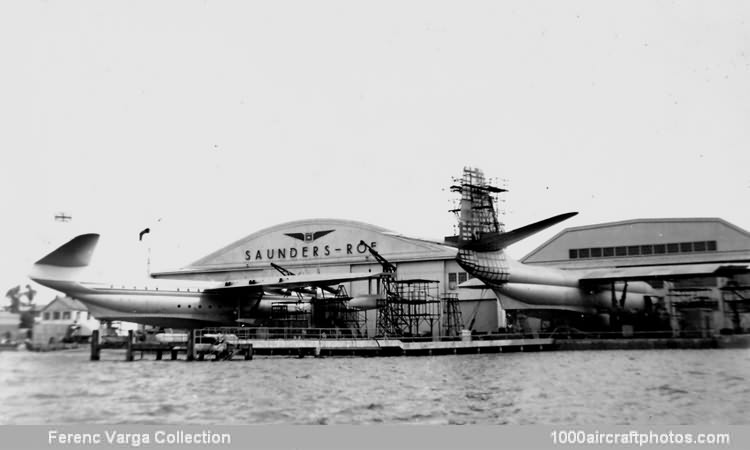
No. 10571. Saunders-Roe SR.45 Princess (G-ALUN c/n SR.901, et al)
Photographed at East Cowes, Ilse of Wight, UK, via Lester A. Lovelock

Saunders-Roe SR.45 Princess

04/30/2011. H. Knowler of the Saunders-Roe Ltd. began design of the Princess originally in 1943, as an extension of the company's ideas for a large long-range commercial flying-boat. In July, 1945, the company was invited by the Ministry of Supply to tender for the construction of an aircraft of this type, and in May, 1946, the Minister of Supply, George Strauss, authorized construction of three flying-boats. At that time British Overseas Airways Corporation (BOAC) had signified their interest in the project, envisaging its use on the direct London-New York route. The three aircraft, c/n SR.901 to SR.903, were registered to the MoS as G-ALUN, G-ALUO and G-ALOP on October 15, 1949.

Early in 1951, BOAC, by then fully committed to landplane operations, decided not to operate the Princess. Thereupon it was officially announced that the three Princesses being built would be completed for the RAF as long-range military transports. In March, 1952, a further official pronouncement declared that the first Princess, powered by ten Proteus 600 engines, would be completed, but that work on the second and third boats would be temporarily stopped to await production of the more powerful Proteus 700 Series engines for which the Princess was designed, and to release capacity for more urgently-needed construction.

The first Princess, powered by ten Bristol Proteus 600 Series engines was flown by a fourteen-men crew (led by Geoffrey Tyson) for the first time on August 22, 1952. In 1953 it was confirmed that flight trials, to include pressurized flights at 30,000 ft (9,150 m), were to proceed up to a total of 100 hours on the first aircraft. The preliminary flight trial program was completed in 1954, when it was decided to suspend further flying until after the installation of more suitable engines, as the trials fully justified expectations in all respects.

Engine technology had had progressed rapidly and the MoS, Saunders-Roe and Bristol tried to agree on how to install six of Bristol's new Orion turboprop. No agreement was forthcoming and all three aircraft were cocooned. Over the next ten years a number of possible buyers emerged (the three aircraft were deregistered in December 1963 as "Change of ownership to Bahamas company") but none took delivery of the aircraft and by 1967 all three had been scrapped.

TYPE. Long-range transport flying-boat with accommodation for up to 220 passengers.

WING. High-wing cantilever monoplane. Aspect ratio 9.5. All-metal two-spar structure in five main units: centre wing, two inner wings, and two outer wings. Center wing, span 27 ft (8.22 m), chord 30 ft 9 in (9.36 m), integral with hull. Inner wings each of 40 ft 3 in (12.95 m) span, tapering in chord from 30 ft (9.15 m) to 26 ft (7.92 m). Outer wings each of 51 ft 6 in (15.70 m) span with tip chord of 11 ft (3.35 m). Wing thickness at root 5.4 ft (1.65 m), at tip 1.3 ft (0.39 m). Electrically-operated slotted flaps on centre and inner wings. Electro-hydraulic mechanical power-controlled four-piece ailerons in each outer wing. Thermal anti-icing, to wing leading-edges and air intakes is provided. Gross wing area 5,250 sq.ft (490.0 sq.m).

HULL. Two-step metal structure. "Double-bubble" arrangement providing two main decks. Pressurised from forward of flight deck to tail breakdown joint aft; pressure differential 8 lb/sq.in (56.2 kg/sq.m). Pressurization by tappings from main engine compressors. Height of hull 24 ft 3 in (7.39 m), beam 16 ft 8 in (5.08 m), draught 8 ft (2.44 m). Retractable wing-tip floats.

TAIL UNIT. Cantilever monoplane type. Dihedral tailplane. Electro-hydraulic mechanical power-controlled rudder in three sections and elevators in two sections each. Tail-unit thermal anti-icing by self-contained kerosene combustion heaters with independent fuel supply and electric ignition from cockpit. Tailplane span: 77 ft (23.48 m). Tailplane chord 22 ft (6.71 m) at root, 6 ft 9 in (2.06 m) at tip. Tailplane area: about 1,000 sq.ft (92.9 sq.m). Fin and rudder area about 600 sq.ft (55.7 sq.m).

POWERPLANT. Ten Bristol Proteus 600 Series turboprop engines, each producing 3,200 shp plus 800 lb (363 kg) jet thrust. Eight engines coupled in four pairs and two single units. Fuel in two integral tanks in each inner wing between engine bays. Total capacity 17,414 gal (65,918 l).

Span (wing tip-floats down): 210 ft 6 in (64.2 m)
Span (wing-tip floats up): 219 ft 6 in (67.0 m)
Length: 148 ft 0 in (45.3 m)
Height: 55 ft 9 in (17.0 m)
Weight empty: 191,000 lb (86,636 kg)
Weight loaded: 330,000 lb (149,686 kg)
Cruise: 358 mph (576 kmh)
Range 5,270 mls (8,481 km)

Created April 30, 2011