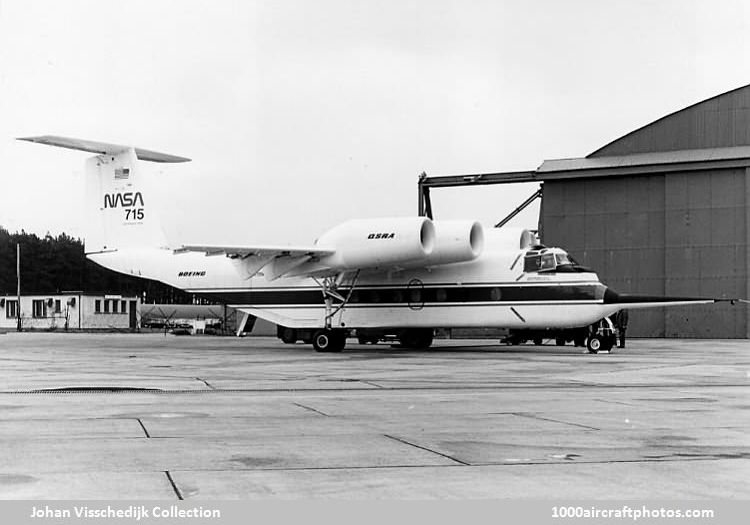
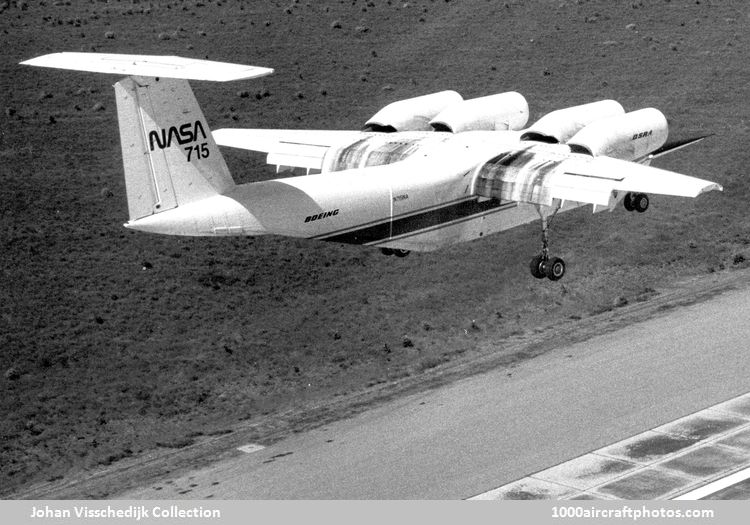
10/31/2007. Remarks by Johan Visschedijk: "The QSRA (Quiet Short-haul Research Aircraft) was developed and constructed by Boeing for NASA Ames Research Center as a research aircraft. Its main purpose was to develop the technology for quiet short-haul airliners by using the Upper Surface Blowing powered lift technology over the inboard Coanda flaps, and the Boundary Layer Control air over the wing leading edges and ailerons.
It was developed from a de Havilland DHC-5 C-8A that was original delivered to the USAF with s/n 63-13687. Later it was loaned to the University of Michigan, registered as N326D. It was registered to NASA Ames on September 3, 1974, and Boeing modified the aircraft by fitting a new wing, a new tail, and four 7,500 lb (3,402 kg) Avco Lycoming YF102 turbofan engines that were taken from the Northrop YA-9A program.
The first flight was made from Boeing Field, Seattle, Washington, USA, on July 6, 1978, subsequently it was delivered to NASA Ames at Moffett Field, California. In a joint test program with the USN the QSRA made 37 touch and go and 16 full stop landings and take offs from the deck of the USS Kitty Hawk, off San Diego, on July 10, 1980."