10/31/2007. Remarks by
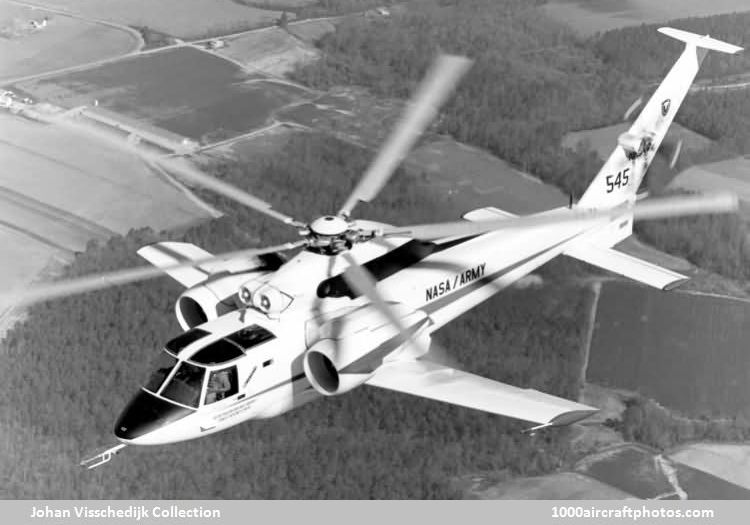
Johan Visschedijk: "Sikorsky built two RSRAs (Rotor Systems Research Aircraft) to a NASA/US Army contract awarded in January 1974. These aircraft had several identity markings:
The first of these high-speed multi-purpose helicopters, coded NASA
"545", made its first flight at Stratford, Connecticut, on October 12, 1976. After 14 hours of testing in 21 flights the initial test phase was completed in February 1977.
On July 21, 1977, it was airlifted to NASA's Langley Research Center, Hampton, Virginia, subsequently it was converted to a compound helicopter fitted with a 45 ft 1 in (13.74 m) span wing, and two 9,275 lb (4,207 kg) st General Electric TF34-GE-400A turbofan engines additional to the two 1,400 shp General Electric T58-GE-5 turboshaft engines driving the standard S-61 rotor system.
(
Ron Dupas Collection)
In 1979 the program was transferred to NASA's Ames-Dryden Flight Research Facility (later redesignated Dryden Flight Research Center), Edwards, California.
"545" was recoded NASA
"740".
The second prototype, NASA code
"546", was built as a compound helicopter, it made its first flight from Stratford on April 10, 1978, was also tested at Langley before being transferred to Ames-Dryden, recoded NASA
"741".
(
Ron Dupas Collection)
In 1987 the second prototype was prepared as a demonstrator for the NASA/Defense Advanced Research Projects Agency (DARPA) advanced rigid X-wing/rotor system concept, whereby the rotor is stopped in cruise flight with the blades then acting as wings to provide lift, whilst engine power is diverted from the rotor system to give pure jet thrust.
(
Ron Dupas Collection)
On November 4, high-speed taxi test were performed (without the X-wing rotor), and the aircraft flew for 16 seconds at an height of 25 ft (7.6 m), the real first flight (still without the X-wing rotor) took place on December 2, 1987. However, for financial reasons the program was ended in January 1988 and the X-wing was never flown."