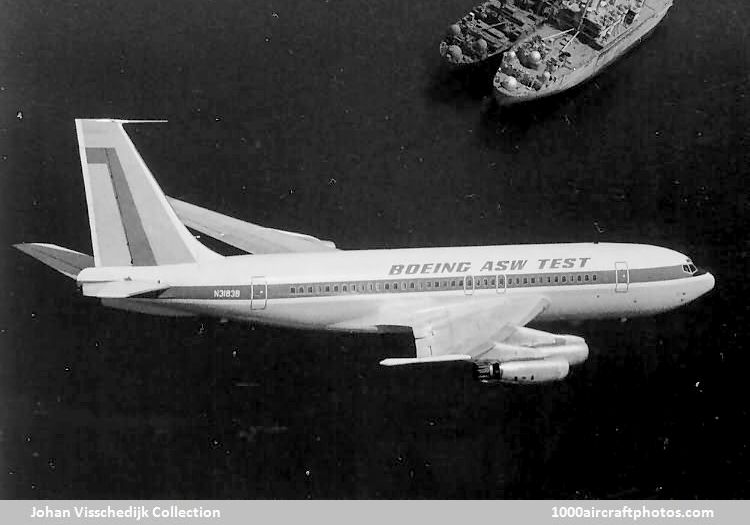
01/31/2008. Remarks by Johan Visschedijk: "This aircraft was delivered to Eastern in September 1961, registered as N8704E and was given the fleet number 704. In September 1969 it was withdrawn from use sold to to the Norwegian charter company
Trans-Polar, being registered on June 4, 1970 as LN-TUW and named Richard Evelyn Bird. On May 24, 1971 the registration was cancelled and the aircraft returned to the USA, and registered again as N8704E it was acquired by Boeing.
Boeing proposed a special version of the 707-320 as a long-range patrol and AWS (Anti-Submarine Warfare) aircraft to meet a Canadian requirement. To demonstrate the potential of such an aircraft, this 720 was converted. It was fitted with dual wing tip-mounted booms that could accept MAD (magnetic anomaly detection) heads up to 10 ft (3.05 m) aft of the wing trailing edge. It was also fitted with sonobuoy storage and launch facilities.
The aircraft was flown in this configuration for the first time on April6, 1972, registered as N3183B. It demonstrated the capability to remain on station for 8 to 10 hours, at a range of 1,000 nautical miles (1,151 mls, 1,852 km) from base, while dropping sonobouys at low (200 ft, 61 m) and high (40,000 ft, 12,192 m) altitudes.
During the ASW test program the aircraft was reregistered to N40102, by October 1979 the aircraft was sighted at Kingman, Arizona, being broken up."