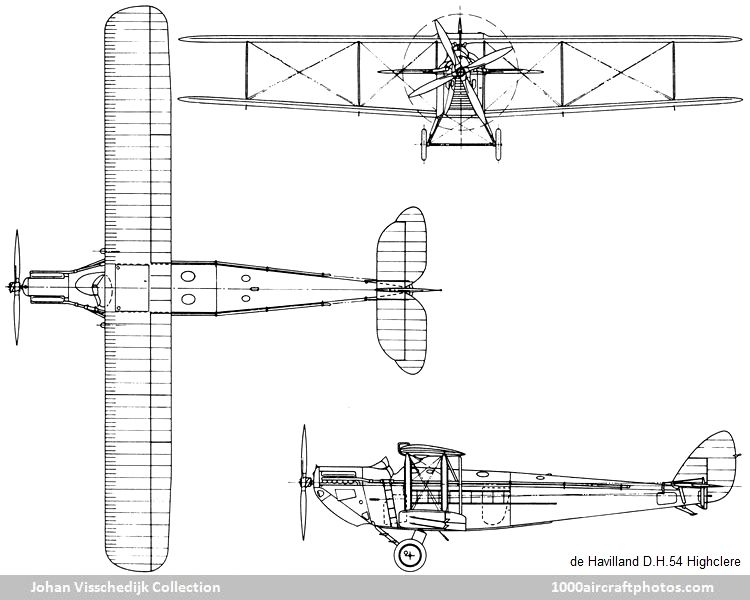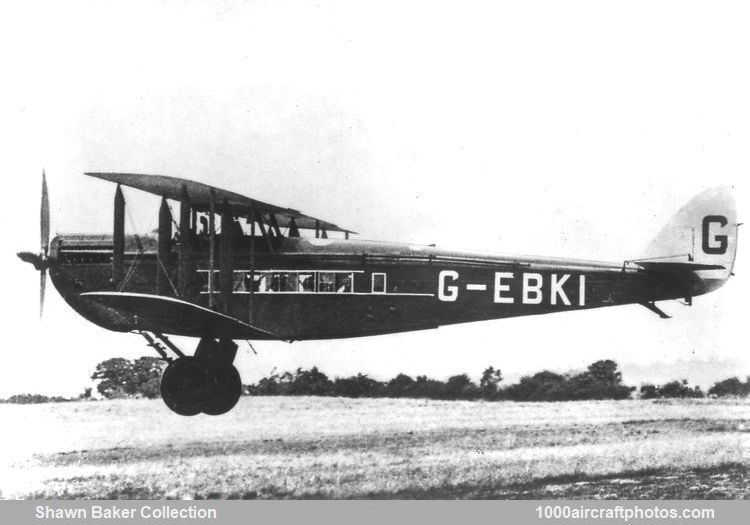
The new aircraft was similar in layout to its predecessor, but had increased power from a 650 hp Rolls-Royce Condor IIIA twelve-cylinder liquid-cooled 60° V-engine. Construction was of wood, with the fourteen passengers carried in an enclosed cabin in the fuselage center-section. The two crew, equipped with dual controls, were in an open cockpit just forward of the top biplane wing. To reduce landing speed, full-span, automatic camber-changing flaps were fitted. As a precaution against ditching, the landing gear could be jettisoned and the fuselage was made buoyant.
So successful was the first flight on June 18, 1925, that passengers were carried later the same day, and its public debut was in the New Types Park at the RAF display at Hendon on 27 June 1925. The D.H.54 was to be used by Imperial Airways on their cross-Channel routes, but by the time the CofA was granted on April 23, 1926 the airline had decided to concentrate on multi-engined passenger aircraft.
No further Highcleres were built and the sole prototype was flown to Farnborough on March 7, 1926, for trials with the Acoustics Department. On November 9, 1926, it returned to Imperial Airways at Croydon for conversion to the D.H.54A as a freighter. Its cabin was to be cleared to allow the carriage of a load of up to 3,000 lb (1,360 kg) of 20 ft (6.10 m) long pipes loaded through a rear cabin door. However, before this conversion could be completed the aircraft was wrecked when the hangar roof fell in under the weight of snow on February 1. 1927."
Span: 68 ft 2 in (20.78 m)
Length: 51 ft 0 in (15.54 m)
Height: 17 ft 7 in (5.36 m)
Wing area: 1,004 sq.ft (93.27 sq.m)
Empty weight: 6,768 lb (3,070 kg)
Loaded weight: 11,250 lb (5,103 kg)
Max speed: 110 mph (177 kmh)
Service ceiling: 10,000 ft (3,050 m)
Range: 400 mls (644 km)