PHIL JUVET COLLECTION
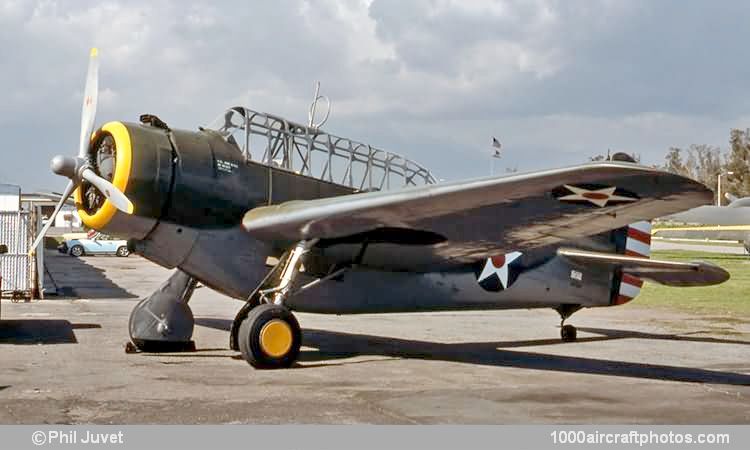
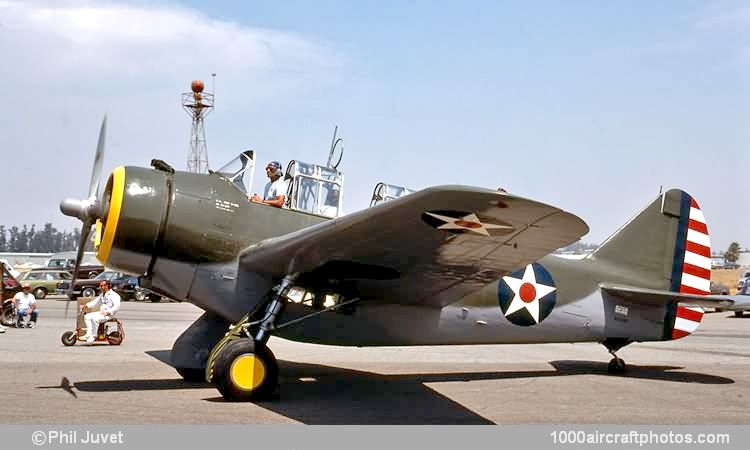
No. 10744. North American NA-51 O-47B (N4725V c/n 25-554)
Photographed at Chino, California, USA, ca. 1979, by Phil Juvet

North American NA-51 O-47B

07/31/2011. The General Aviation GA-15 was designed to provide the USAAC with a new generation of observation aircraft, improving radically on the performance and capability of the high-wing, open cockpit monoplanes that had been the norm for observation types since WW I. To match the standards being achieved by the new bombers and fighters, the Army specified that its new observation craft should be of all-metal construction, with a max speed over 200 mph (322 kmh), service ceiling over 20,000 ft (6,100 m), range of at least 700 mls (1,127 km), crew of three and defensive armament.

These features were provided in the GA-15 design, which had a mid-wing, an 850 hp Wright R-1820-41 Cyclone engine and crew of three in tandem beneath a long 'glasshouse' enclosure. For visual observation, an additional crew position was built into the deep fuselage beneath the wing, with front, side and ventral windows; this position was accessible from the centre cockpit, while the third crewman in the rear of the cockpit manned the flexibly-mounted 0.30 in (7.62 mm) gun for rear defense. A similar gun in the wing was fixed to fire forwards and aimed by the pilot.

By the time the prototype GA-15 was completed, the company had be renamed the Manufacturing Division of North American, and the aircraft was redesignated NA-15. In the early summer of 1935 it was tested at Wright Field in USAAC markings but with civil registration X2079; its purchase as the
XO-47 was confirmed in January 1936, and it was serialed 36-145.

On February 19, 1937, a production contract with North American was approved for 109 NA-25 O-47As (s/n 37-260 to 37-368, c/n 25-203 to 25-311) and these aircraft began to appear from the Inglewood plant later that year, followed by 55 more NA-25 O-47As (s/n 38-271 to 38-325, c/n 25-541 to
25-595) on a second contract dated October 20th, 1937.

The O-47As had 975 hp R-1820-49 engines and most were delivered in natural metal finish; 48 of the second batch were procured for the Air National Guard. Production was completed with 74 NA-51 O-47Bs (s/n 39-065 to 39-138, c/n 51-978 to 51-1051), with 1,060 hp R-1820-57s, an increase of 50 gal (189 l) in internal fuel capacity and higher gross weight. Most O-47As and O-47Bs had revised lower fuselage lines, with less transparencies for the observer.

The O-A7s were well distributed through the observation squadrons by 1941, but saw little operational service after America entered the WW II. A few were used from overseas bases after the Japanese attack on Pearl Harbor, and for a few months in early 1942, some submarine patrols were flown off the US coasts.

Thereafter, the O-47s were relegated to training, target-towing and other utilitarian duties. A few O-47Bs survived the war and were modified for commercial use on restricted category certificates, issued on August 1, 1945. In this role, they operated as single seaters with the centre and rear seats removed and cargo tie-downs fitted instead.

N4725V was produced as a NA-25 O-47A under s/n 38-284, struck off charge it was then modified to O-47B standard. It became one of two O-47s used in the famous movie 'Flight of the Phoenix'. On February 22, 1974 it was registered to the Planes of Fame Inc. of Chino, Califormia, crashed at Porterville on June 11, 1982, but is presently under long-term restoration to airworthiness at Chino.

Created July 31, 2011