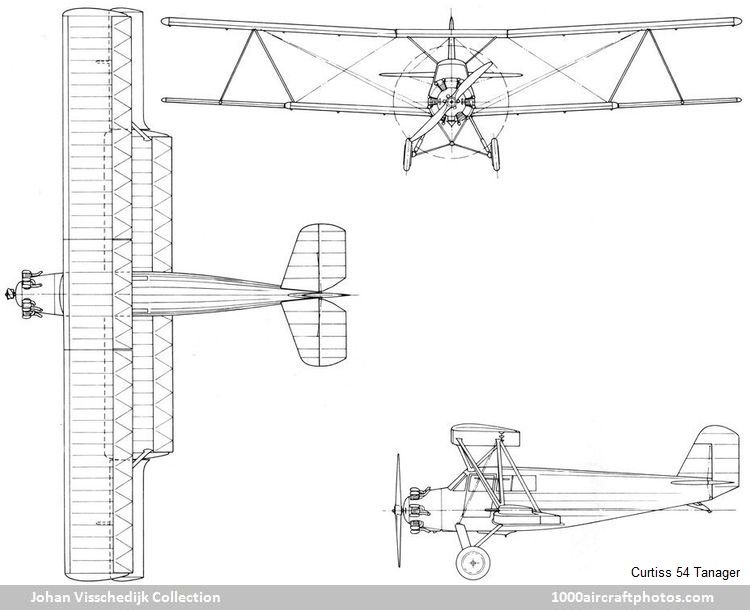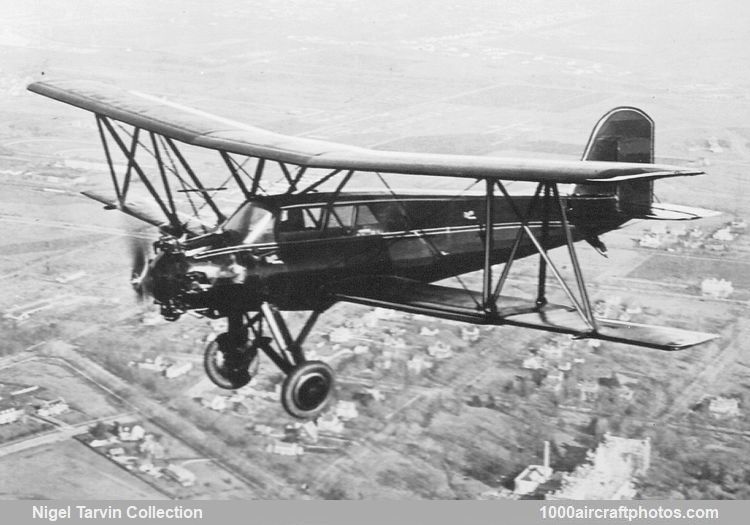
The low-speed requirements were met with a long-span cabin biplane using full-span trailing edge flaps on both wings and full-span Handley Page automatic slots on the leading edges. These added 33 and 50%, respectively, to the overall lift coefficient. Major safety features were floating ailerons installed outboard of the lower wingtips that trimmed automatically to fair with the relative air flow regardless of the aircraft's angle of attack, a long-stroke landing gear to absorb the impact of hard landings, and a reinforced cabin structure.
Improved controllability was a major safety feature; coordinated turns could be made with ailerons alone and high-rate descents right onto the ground could be made by holding the control stick fully back throughout the descent from any altitude. The structure was conventional, with riveted aluminum tube fuselage and wood frame wings, all fabric covered. Airfoil was the well-proven Curtiss C-72 and powerplant was the 185 hp Curtiss R-600 Challenger two-row six-cylinder air-cooled radial engine.
First flown on October 12, 1929, the three-seat Tanager won the $100,000 prize, which just about equaled the development cost, and Curtiss was promptly sued for that sum by runner-up Handley Page for unauthorized use of the patented slots. The life of the Tanager was short; it was destroyed in 1930 when the grass on which it was parked caught fire.
Although some Tanager wing features (less the slots) were soon tried on a Travel Air 4 biplane and on a Curtiss 50 Robin, the Tanager had no direct effect on subsequent Curtiss civil designs. The added features were expensive, and new designs of the early depression years were kept as simple as possible to minimize costs. The first application of wing flaps and slots to a subsequent Curtiss military design was on the XA-8 Shrike.
Span: 43 ft 10 in (13.35 m)
Length: 26 ft 8 in (8.12 m)
Height: 11 ft 4 in (3.45 m)
Wing area: 333 sq.ft (30.93 sq.m)
Empty weight: 1,959 lb (888 kg)
Loaded weight: 2,841 lb (_1,289 kg)
Max speed: 112 mph (180 kmh)
Cruise speed: 95 mph (153 kmh)
Landing speed: 37 mph (60 kmh)
Climb: 700 ft (213 m)/min
Service ceiling: 12,000 ft (3,810 m)
Range: 535 mls (861 km)