08/22/2022. Remarks by
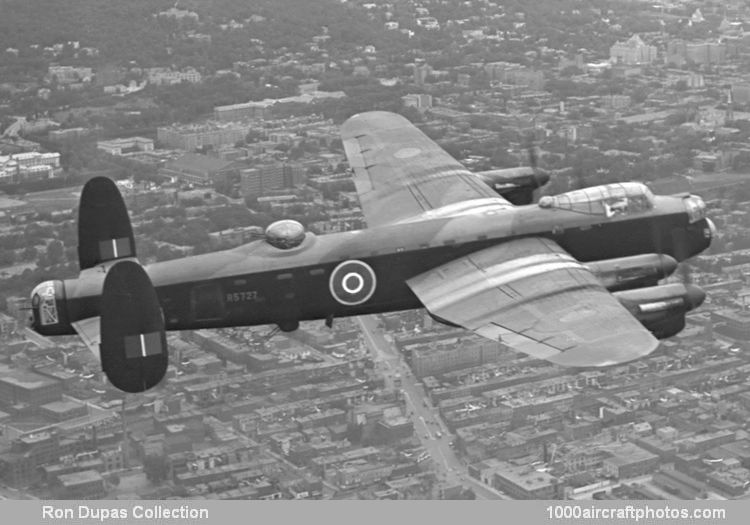
Johan Visschedijk: "Destined to be the pattern aircraft for the Canadian
Lancaster B.Mk.X production this aircraft became the first Lancaster to fly the Atlantic.
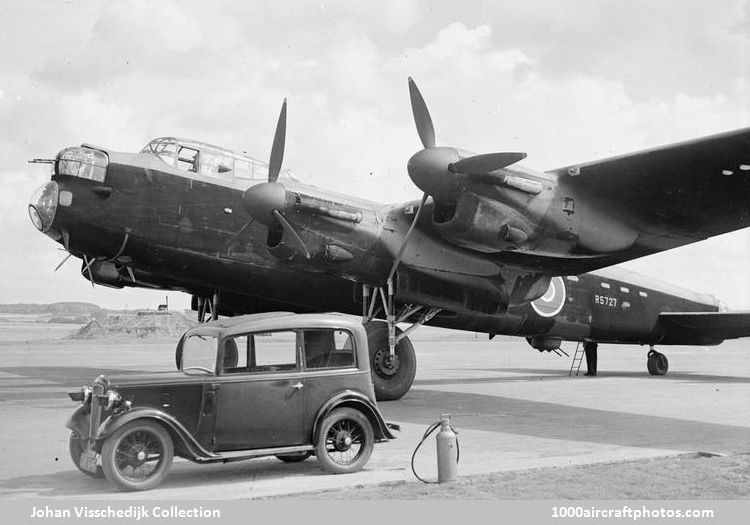
Lancaster B.Mk.I (R5727) at Prestwick (
Johan Visschedijk Collection)
On August 24, 1942 it was flown by Clyde Pangborn and his crew from Prestwick, Scotland, to the National Steel Car factory at Malton, near Toronto, Ontario, Canada (the company was renamed Victory Aircraft on November 4, 1942). Subsequently it was used for demonstrations in Canada and the USA.
In 1943 the Canadian Government took the decision to set up a transatlantic air service, an idea which had been under consideration for some time. The service was to be non-commercial, with air mail service to the Canadian forces overseas being the prime purpose, but some vital express as well as certain military, Governmental, and essential war service passengers would also be carried. The aircraft were to be owned by the Canadian Government Trans-Atlantic Air Service (CGTAS) but would be operated by Trans-Canada Air Lines (TCA) for the Government. Canadian-built Avro 685 Yorks were to be used but to initiate the service the British Ministry of Aircraft Production agreed to allow the Lancaster B.Mk.I R5727, then in North America, to be used.
In March 1943 Victory Aircraft removed the Service equipment and the aircraft was turned over to TCA on the 19th of that month, but was then requisitioned to fly much-needed materials from Moncton, New Brunswick, to Goose Bay, Labrador. On May 15, 1943, R5727 was flown to England on 15 May where it was given a pointed plywood nose, ten passenger seats, long-range tanks, and new engines.
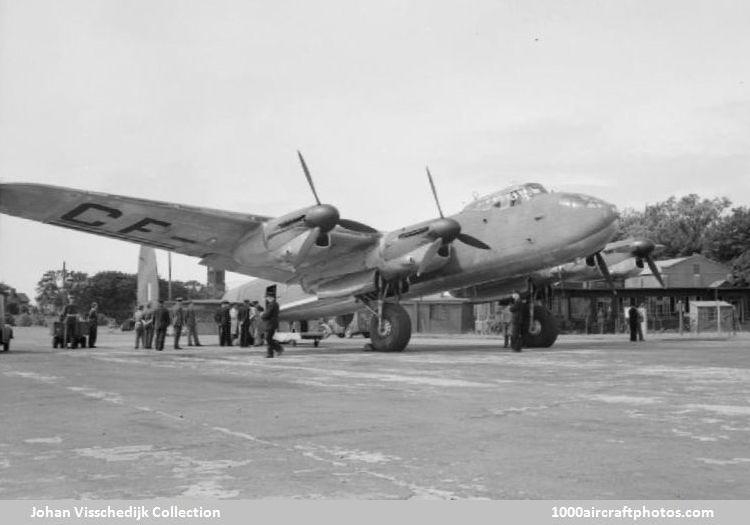
Lancaster Mk.I (CF-CMS) (
Johan Visschedijk Collection)
Redesignated Lancaster Mk.I and registered CF-CMS, it entered service with Trans-Canada Airlines on June 7, 1943, and made the first Atlantic crossing for the CGTAS from Prestwick to Dorval Airport, Dorval, Quebec, on July 1-2, 1943. Above CF-CMS is pictured at Prestwick, after a flight from Montreal, Quebec, mid-1944.
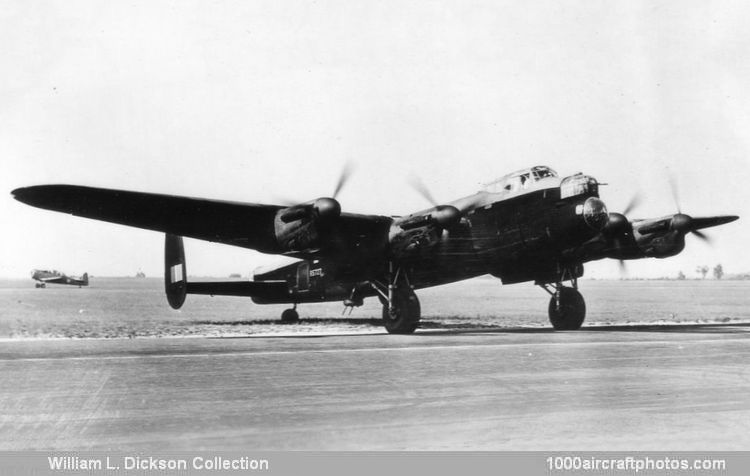
Lancaster B.Mk.I (R5727) (
William Dickson Collection)
11/18/2002. Remarks by
Carlo Soliani: "Avro Lancaster B.Mk.I. This aircraft belongs to the very first batch of B.Mk.I production (October 1941) because it is equipped with thin, rectangular windows on the fuselage sides, a typical detail of the twin-engined Manchester. In effect the first batch of B.Mk.I production was carried out by coupling the new Lancaster wing platforms with Manchester airframes already under construction. Moreover, the aircraft depicted seems to be equipped with a small Frazer Nash ventral turret for two 7.7 mm (0.303 in) guns. The fuselage windows and the ventral turret disappeared on B.Mk.Is of later batches of production."