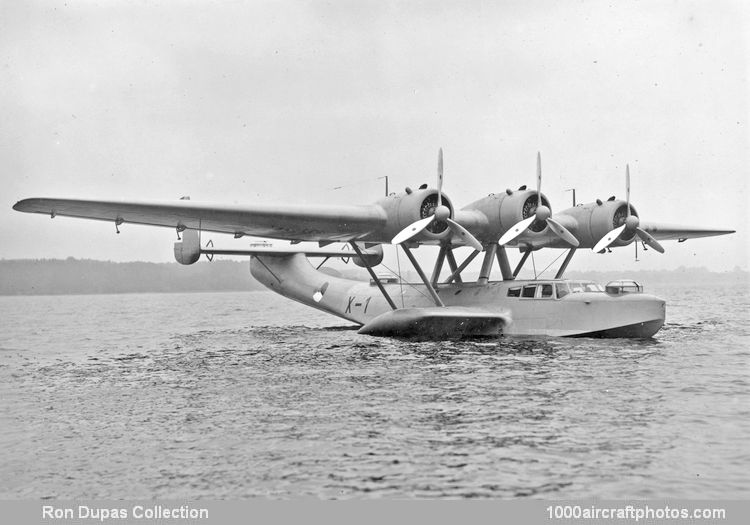
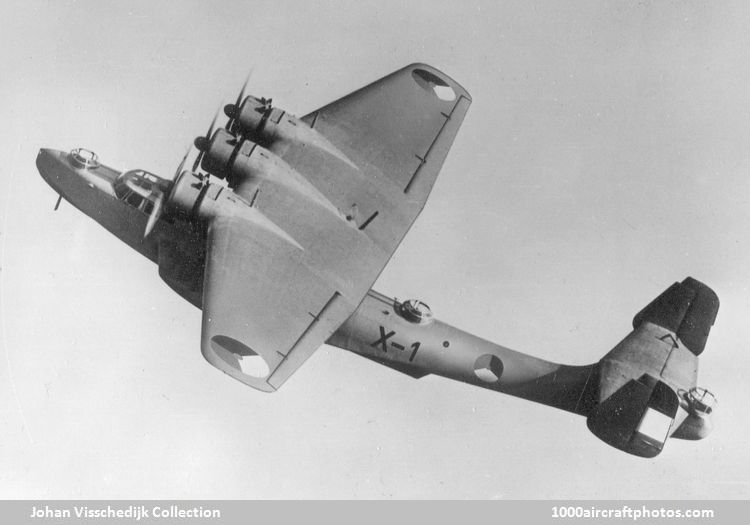
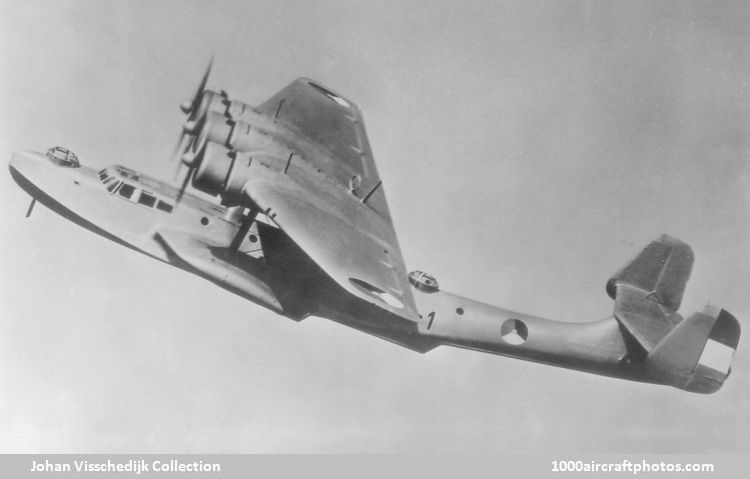
01/13/2004. Remarks by Alfred Damen: "The Do 24 was largely designed around a Royal Netherlands Navy specification to replace their ageing Dornier Wal flying boats in the Marine Luchtvaart Dienst (MLD = Navy Aviation Service). The MLD wanted the same reliability and rugged seaworthiness the Wal offered (due to the unique Flossenstummeln (sponsons) on both sides of the aircraft) but with a much improved performance.
(
Johan Visschedijk Collection)
The initial contract for six Do 24 K-1s was signed in 1936 (MLD s/n X-1 to X-6) to be built by Dornier in Friedrichshafen. The X-1 to X-3 were directly shipped to the Dutch East Indies in 1937, probably to the main seaplane base at Morokrembangan (near Surabaya). As an exception the X-4 was delivered to Fokker's Aviolanda subsidiary in Dordrecht to be fitted out with Dutch avionics and armament.
As the MLD envisaged a conflict in the east they resolved to procure 72 Do 24 Ks. Fokker, de Schelde and Aviolanda would build the majority as Do 24 K-2s under license in the Netherlands. An additional order for 24 Do 24 K-1s was placed with Dornier (MLD s/n X-7 to X-30) and these were delivered during 1938 and 1939. During 1939 the X-30 was upgraded to Do 24 K-2 standard and reserialed X-37. The X-37 was since then known as the VIP plane for Navy brass.
In the meantime Aviolanda and de Schelde were tooling up to produce the bulk of the seaplanes, but only six Do 24 K-2s (MLD s/n X-31 to X-36) had been delivered by May 10, 1940 when Germany attacked the Netherlands. The Germans found a large number of unfinished Do 24 K-2s as well as spares when they occupied the production plants. Production of these planes continued under German supervision for most of WW II.
The X-1 flew reconnaissance flights and operational sorties against Japanese shipping with the MLD in the Dutch East Indies until March 2, 1942. As the Japanese were at that time invading mainland Java it was decided to evacuate all flying assets to either Australia or Ceylon. The X-1 left lake Wendil on Mar 2, 1942 at 22.00 hrs with twenty persons jammed aboard (while the normal complement was six!) Many of these passengers were women and children. The X-1 reached Roebuck Bay, near Broome, early in the morning of March 3, 1942. They anchored in the bay together with four other MLD Dorniers, Australian Catalinas and a large Short flying boat. Unable to reach the shore because of the tide, it was decided to wait on board of the aircraft.
But at 09.20 local time a fierce attack was carried out by nine Japanese fighters (Mitsubshi A6M2 Zero's) led by Lieutenant Zenziro Miyano. In this attack the X-1, as well as the X-3, X-20, X-23 and X-28 were riddled with bullets, exploded and sank. Most of the escapees perished either from Japanese bullets or by drowning in the fierce ebb currents of Roebuck Bay. Some years ago it was established that the wrecks of the flying boats are still on the bottom of this forlorn Northwest Australian bay."
09/30/2016. Remarks by
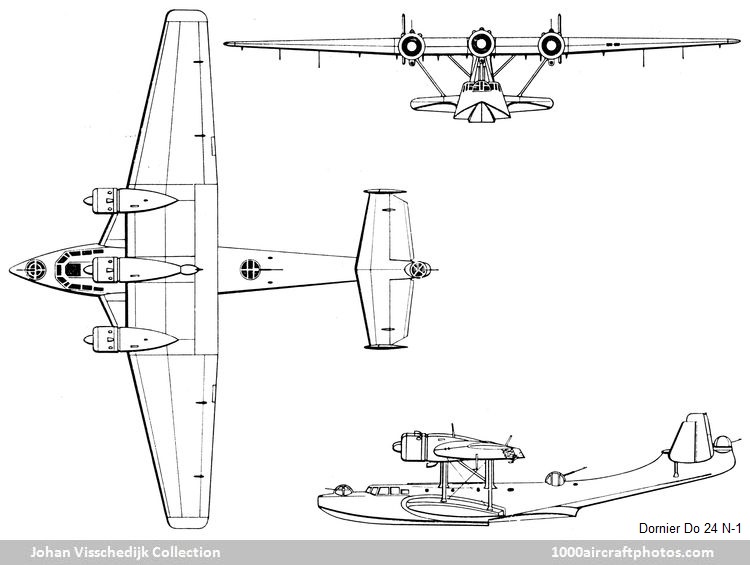
Johan Visschedijk: "During 1935, the Dornier-Werke obtained an order from the Dutch government for the development of a flying boat suitable for use by the Royal Netherlands Naval Air Service in the East Indies. To meet this requirement, the German concern produced the Do 24, a semi-cantilever monoplane of all-metal construction with Flossenstummeln (sponsons) for lateral stability on the water. At the time that design work on the Do 24 was initiated, the Do 18 had just begun flight trials, and the general layout of the flying boat for the Dutch government followed that of the earlier aircraft.
Three prototypes were built, the third, the Do 24 V3, being intended as the prototype of the export model, was actually the first to fly. The initial test flight took place on July 3,1937, power being provided by three 890 hp Wright R-1820-F52 Cyclone radials. The Do 24 V1 did not fly until January 10, 1938, this aircraft being powered by three 600 hp Junkers Jumo 205C diesel engines as was also the Do 24 V2. Both the Do 24 V1 and V2 were later to participate in the invasion of Norway, a 0.311 in (7.9 mm) MG 15 machine gun being installed in the bow and tail positions and a 0.787 in (20 mm) MG 151 being housed in a power-operated dorsal turret. Twelve 110 lb (50 kg) bombs could be carried under the wings.
The Do 24 V3 was delivered to the Netherlands late in 1937, and a further eleven Cyclone-powered machines were built by Weser Flugzeugbau under the export designation Do 24 K, these being delivered to the Dutch Navy during 1938-39. A manufacturing license for the Do 24 K was acquired by the Dutch government, the Aviolanda company building the fuselages and the De Schelde company manufacturing the wing assemblies. Dutch production deliveries commenced early in 1939, 25 of an order for 48 having been delivered by the time the Netherlands were invaded, and a number of aircraft were in service in the East Indies when the Pacific War began. On December 23, 1941, five of the Do 24 K flying boats were destroyed in an attack on Davao in the Philippines, and three days later four more Do 24 Ks were destroyed at the moorings on Tonduno Lake by strafing Japanese fighters.
Five Do 24 Ks used for training at Morokrembangan, near Surabaya, were flown to Australia in February 1942, and during the following month, the surviving operational Do 24 Ks were also transferred to Australia. Two made forced landings en route, one being destroyed, but the remaining four reached Broome, being sunk at their moorings there in a Japanese air attack on March 3, 1942. Five of the Do 24 Ks originally used for training were taken over by the RAAF (under the designation A-49), and the sixth Do 24 K, which had survived the Broome attack as a result of a fuel shortage which had necessitated a forced landing at Wallal while en route to Broome, was used by the Netherlands Forces Intelligence Service on clandestine operations until it was handed over to the RAAF in October 1943.
The Do 24 Ks still under construction in the Netherlands at the time of the German occupation were transferred to Germany, re-equipped, and employed on air-sea rescue duties under the designation Do 24 N-1. Production of the Do 24 was continued in the Netherlands after the occupation, Weser Flugzeugbau supervising the program, sixteen being completed in 1941 under the designation Do 24 T. The Do 24 T-1 and T-2 were intended for both maritime reconnaissance and transport roles, and differed solely in internal equipment, both being powered by 1,000 hp BMW/Bramo Fafnir 323R-2 nine-cylinder air-cooled radial engines. Armament was identical to that of the Do 24 V1 and V2. During 1942, the former CAMS (Chantiers A ro-Maritimes de la Seine) plant at Sartrouville, France, was brought into the Do 24 T program, delivering two flying boats in that year.
A total of 154 Do 24 T flying boats was completed in the Netherlands from 1942 until the liberation, and the Sartrouville plant produced a further 46, although not all of these were received by the Luftwaffe as some unfinished machines at Sartrouville at the time of the German withdrawal were completed for the French Navy, Flottille 9F Tr (Transport) being formed on December 5, 1944, to operate these aircraft. The first two Do 24 flying boats for Flottille 9F were delivered from Sartrouville to Saint Mandrier on December 29, 1944, and in January 1945 twenty Do 24s were under construction at Sartrouville for the French Navy, these subsequently serving in the transport role with Flottille 9F until January 1, 1946, when that unit became Escadrille 30S. The Do 24s served with Escadrille 30S in the air-sea rescue role and performed similar duties with Escadrille 20S, the latter unit being disbanded in October 1949. Escadrille 30S continued operating Do 24s until disbanded on January 15, 1952, and the last flying boats of this type in service with the French Navy were operated by the flying boat pilot's school at Karouba, Escadrille 53S, until sold to Spain in 1953.
One Do 24 T-1 entered service with the Royal Swedish AF, this particular aircraft having made a forced landing at H llevik, Sweden, on October 31, 1944. As the Swedes had no aircraft suitable for the air-sea rescue role, the Do 24 T was taken over by the Royal Swedish AF as the Tp 24, compensation being paid to Germany. There was an agreement that all German aircraft and ships in Sweden at the end of the war that had left the area of Germany that was to become the Russian Zone were to be handed over to the Soviet Union, and it is an interesting corollary to the story of the sole Swedish Do 24 T that the aircraft was eventually claimed by the Soviet Union, a Russian crew arriving in Sweden to ferry the aircraft to the USSR in August 1951! In the spring of 1944, twelve Do 24 T-3s were purchased by the Spanish government to equip an air-sea rescue squadron subsequently based at Pollensa, these flying boats remaining in service until the 1970s."
The following data relate to the Do 24 T.