02/08/2026. Remarks by
Johan Visschedijk: "The semi-open high-wing monoplane
Henschel Hs 126 served as a short-range and army reconnaissance aircraft at the outbreak of war. However, the
RLM had already called for a more modern aircraft in 1937: a tactical reconnaissance aircraft that, in addition to good performance, was to offer uninterrupted all-around visibility for self-defense and provide space for three crew members, with the third crew member serving as a rear-facing gunner on the upper fuselage.
Three companies participated in the tender: Arado offered the
Ar 198, a cantilever high-wing monoplane with a fuselage that was fully glazed on the underside. Blohm & Voss proposed the BV 141 project, in which the fuselage housed the engine, while the crew sat in a special all-view cockpit on the upper wing surface.
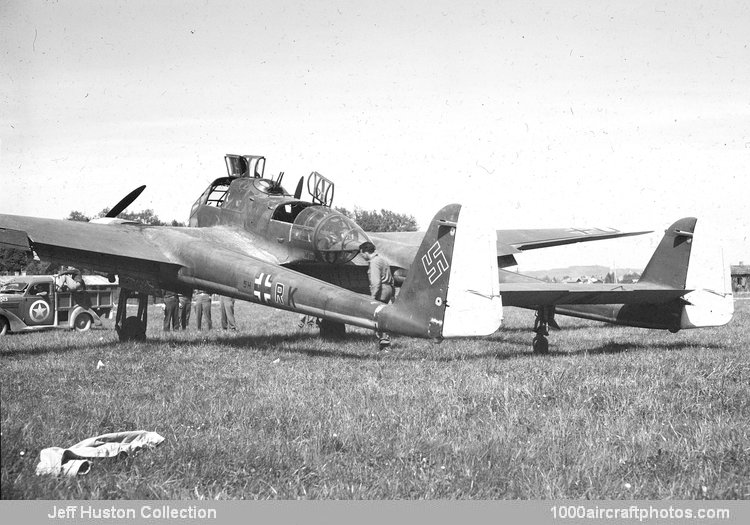
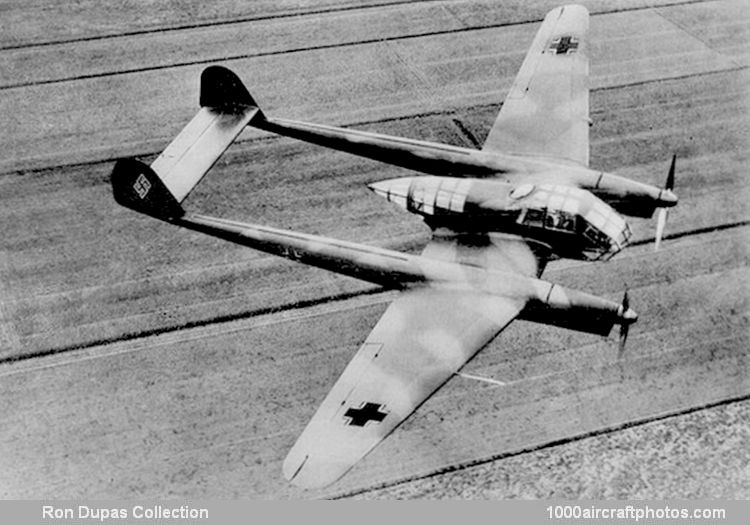
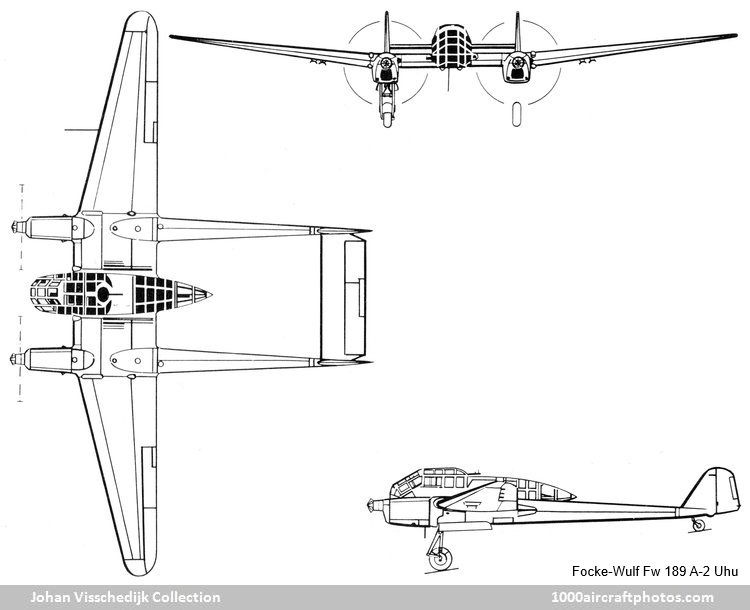
Chief designer Kurt Tank commissioned Dipl.-Ing. E. Kosel to design a completely new type of aircraft. Based on his suggestions, a twin-engine, low-wing monoplane with retractable landing gear was developed, a twin-fuselage aircraft whose extended engine nacelles served as the tail boom. The three-man crew sat in a fully glazed cockpit between the two engines and had excellent forward visibility, which, as Tank noted, was not impaired even in very heavy rain. To the rear, there was an almost unobstructed field of fire. The aircraft was powered by two Argus As 410 A-1 twelve-cylinder, air-cooled engines, each producing 465 hp. The type was designated Fw 189 Uhu (Eagle Owl).
Fw 189 V1 (D-OPVN) (
Ron Dupas Collection) APS No. 201
The Fw 189 V1 (V for experimental aircraft or prototype) was still equipped with the slightly less powerful As 410 engines, each producing 430 hp. The testing of the three Fw 189 V1, V2, and V3 prototypes in mid-1938, overseen by chief test pilot Hans Sander, was satisfactory, leading to an order for four more prototypes. Initially, difficulties arose due to sudden drops during landing, caused by airflow separation between the fuselage and tail boom. This problem was remedied by increasing the curvature of the leading edge, as suggested by engineer Mathias. The aircraft was aerobatic, and Tank, who personally performed the first takeoffs with the Fw 189 V1, executed loops, rolls, turns, and spins flawlessly.
The Fw 189 V3 served as a test aircraft for a planned Fw 189 A-series and for special equipment. It was equipped with an automatically variable-pitch Argus propeller. The Fw 189 V4 was identical to the Fw 189 V3, like its predecessors, a reconnaissance aircraft, and also served for testing. The Fw 189 V5 became the prototype for a Fw 189 B-series of trainer aircraft, featuring a modified cockpit and dual controls. In 1939, three Fw 189 B-0 trainers and ten Fw 189 B-1 trainers were ordered. To the surprise of the Ministry and industry, however, the short-range reconnaissance units at the time were reluctant to consider a new aircraft, as the Henschel Hs 126 had proven so successful. Therefore, there was no immediate urgency.
A special version, the Fw 189 D, also designated the seventh prototype (Fw 189 V7), was intended to be equipped with floats for experimental purposes, but this order was later cancelled. Incidentally, the first V-types had single-leg landing gear, which was later replaced by so-called swing-arm landing gear. A Fw 189 C-series was planned by the RLM as a ground-attack aircraft. For this reason, a prototype was designated for comparison with the Henschel Hs 129 ground-attack aircraft. The Fw 189 V1 was therefore given in 1939 a significantly smaller and armored cockpit, increased armament in the form of dummy guns, and the somewhat more powerful As 410 A-1 engines with variable-pitch propellers, which had already been used in the Fw 189 V2 and V3. Two different cockpits were tested under the designations Fw 189 V1 a and V1 b. However, the aircraft proved disappointing in this configuration.
In 1940, a Fw 189 V6 was again converted into a ground-attack aircraft. It received an armored cockpit for two men and an extremely powerful armament consisting of two 0.591 in (15 mm) MG 151 machine guns, four 0.311 in (7.9 mm) MG 17 fixed machine guns, and one 0.311 in (7.9 mm) MG 81 Z machine gun. The fuel capacity was reduced to 73 gal (276 l), and a FuG 25 radio was used for communication. Furthermore, the landing gear was reinforced. The takeoff weight of this version increased from 9039 lb to 10,229 lb (4,100 to 4,610 kg).
Attempts commissioned by the RLM to convert the Fw 189 into a ground-attack aircraft proved unsatisfactory because the design was simply not suited for such tasks, and the engines proved far too weak. The competing Hs 129 very soon received engines almost twice as powerful. The Technical Office therefore opted for the Henschel Hs 129, which had been intended for this task from the outset.
In the summer of 1940, Focke-Wulf received its first production order for the reconnaissance version, the Fw 189 A-0. It was equipped with As 410 A-0 engines and automatic Argus variable-pitch propellers. Its armament consisted of two forward-firing, fixed MG 17 machine guns in the wing roots and two movable, rearward-firing MG 15 machine guns. One MG 15 was mounted in a large lens mount elevated in the B-position, the second in a tail mount in the rear position. The bomb rack was designed for four 110 lb (50 kg) bombs, attached to four bomb bay doors on the undersides of the wings, and for two smoke grenade launchers.
The radio equipment consisted of a FuG 17, a VHF radio for voice and telegraphy. It was suitable for both ground-to-air and interplane communication. Furthermore, the Fw 189 A-0 was equipped with a G 5 direction-finding and targeting system and a FuG 25 a identification device. The aircraft could be optionally fitted with the Rb 50/30, 20/30, 15/18, and 21/18 continuous-motion cameras, along with a handheld camera. Each integrated continuous-motion camera was driven by an electric motor with continuously variable speed control.
The Fw 189 V4, with a takeoff weight of 3950 kg, served as the prototype for this pre-production aircraft. The subsequent Fw 189 A-series aircraft were initially built in Bremen, but later production was transferred to the SNCASO factories in Bordeaux and Mérignac, France, and to Aero, Prague, Czechoslovakia. The Fw 189 A-1 series was identical to the Fw 189 A-0 but was already equipped with the slightly more powerful As 410 A-1 engine. It was a logical step to experimentally install French engines already available in Bordeaux into the Fw 189.
An Fw 189 A-1 was therefore equipped with two 700 hp Gnome & Rhône 14 M air-cooled radial engines under the designation Fw 189 E. However, the prototype was destroyed, and only one aircraft was built, which was later used by Field Marshal Kesselring as a courier plane.
At the end of 1941, the Fw 189 A-2 series began production, featuring enhanced defensive armament with two MG 81 Z cannons instead of the MG 15s. A small series of Fw 189 A-2 Trop aircraft was equipped for tropical use. The Fw 189 A-3, also built in 1941, was a dual-control trainer and largely identical to the Fw 189 B version. From 1942 onward, the Fw 189 A-4 was built, an improved Fw 189 A-2 with heavier armor and better armament. The fixed MG 17 cannons were replaced by MG FF cannons.
An Fw 189 F-1 (built in 1943) was fitted with As 411 engines, producing 575 hp. Production of this model began at the Mérignac factory. However, due to the war, only 17 aircraft were built.
A total of 850 Fw 189 A aircraft were produced, primarily as reconnaissance planes, with some used as trainers, air ambulances, or touring aircraft. Kurt Tank, who had flown the Focke-Wulf Fw 58 Weihe as a touring aircraft for many years, used the faster Fw 189 for his air travel during the war.