11/17/2026. Remarks by
Johan Visschedijk: "By 1907 the Fransman Louis Peyret was the chief engineer of Louis Blériot and assisted in the design of a tandem wing configuration aircraft. After WWI he constructed the Peyret Tandem, a tandem wing glider. Flown by Alex Maneyrol, a Daily Mail £1,000 prize was won on October 21, 1922. In 1924 Peyret obtained a patent for his tandem wing design. He builds more of this and conventional types, like the Albessard Triavion and the Peyret-Mauboussin PM X.
On August 17, 1929, the Peyret VI single-seat tandem wing monoplane made its first flight. However, due to yaw instability that persisted despite various modifications the aircraft failed to obtain its airworthiness certificate. Louis Peyret passed away in 1933.
Established on July 24, 1934, the Société Française de Construction Aéronautique (SFCA) purchased Peyret’s patent rights. In 1935 SFCA developed and built the tandem wing monoplane, designated SFCA Taupin, it was very similar to the Peyret VI. By October 1935, the Taupin was first flown by SFCA chief test pilot Louis Clément.
(
Walter van Tilborg Memorial Collection)
Of the SFCA Taupin 48 examples were produced, only two went abroad, one to Switzerland and one to the French colony Algeria.
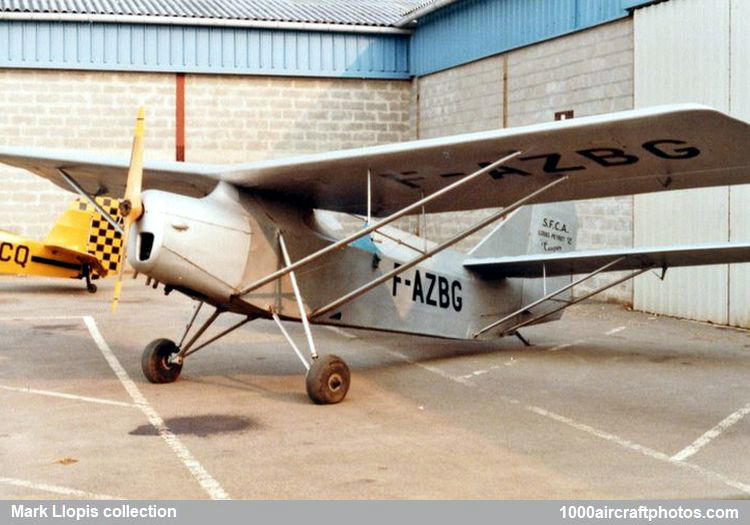
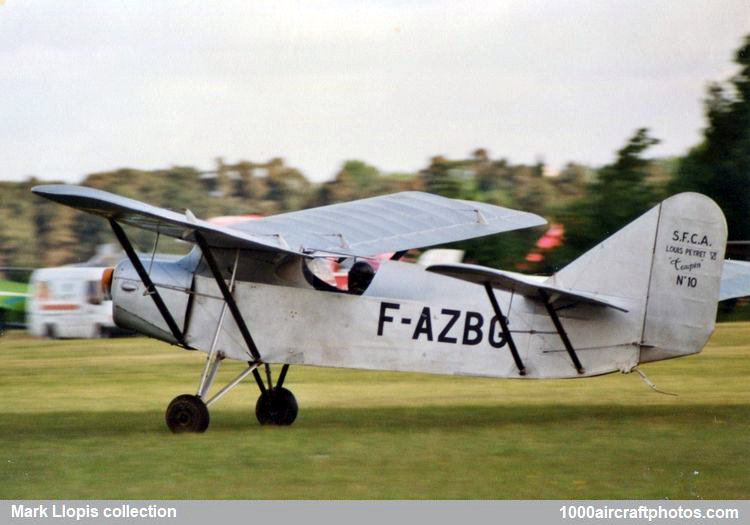
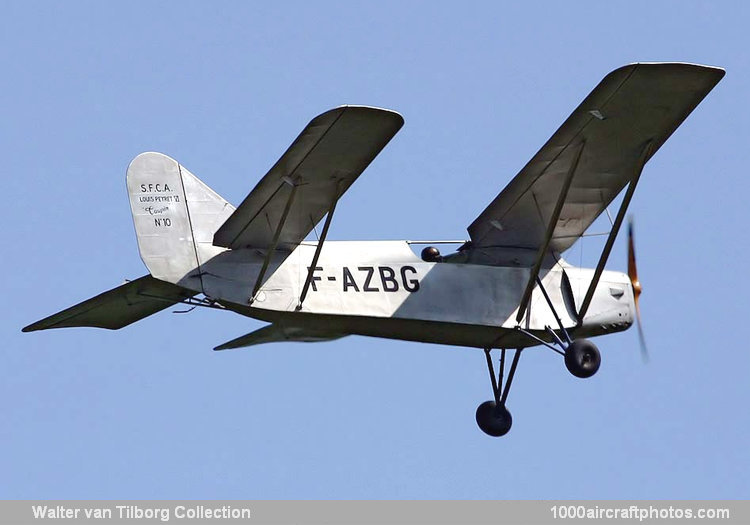
The pictured aircraft was registered as SFCA Taupin, F-APGB on March 19, 1937, as Peyret Taupin, F-PMEM on May 5, 1965 (deregistered in 1970), and as SFCA Peyret Taupin Type VI, F-AZBG on December 29, 1993. Despite the different designations, the type is still the original SFCA Taupin.
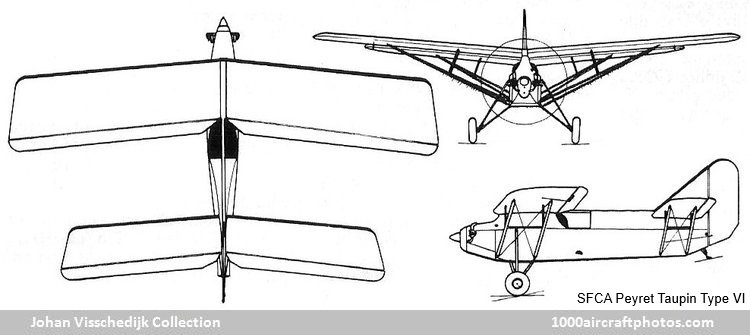
Type: Single-seat light tandem monoplane.
Wings: Tandem rigidly-braced monoplane. Both wings attached to the upper fuselage longerons and braced to the lower longerons with parallel struts. Entire trailing-edges of both wings hinged and interconnected for use as differentially-controlled ailerons and camber-changing flaps. The flaps on the rear wings are also operated as elevators. Wooden structure with fabric covering.
Fuselage: Wooden construction, with plywood covering.
Tail unit: Normal fin and rudder. Flaps on rear wing act as elevators as well as camber-changing flaps and ailerons in con-junction with the flaps on the main forward wing. Wooden structure with fabric covering.
Landing gear: Split type. Consists of two telescopic legs with the upper ends attached to the upper fuselage longerons and the lower ends hinged to the lower longerons by steel-tube Vees. Low-pressure wheels.
Power plant: One 30 hp Mengin two-cylinder opposed air-cooled engine. Fuel tank in fuselage.
Accommodation: Open cockpit aft of main wing.
SFCA produced also a two-seat side-by-side dual control sports and training version, designated SFCA Taupin 5/2, also referred to as Cinq-Demi Taupin. It was fitted with a 60/70 hp Régnier four-cylinder air-cooled inverted in-line engine. It had exactly the same wings as the single-seat Taupin, except that a small center-section of 3 ft 3.3 in (1 m) span had been introduced into the forward wing. Only four were built, one went also to the French colony Algeria."