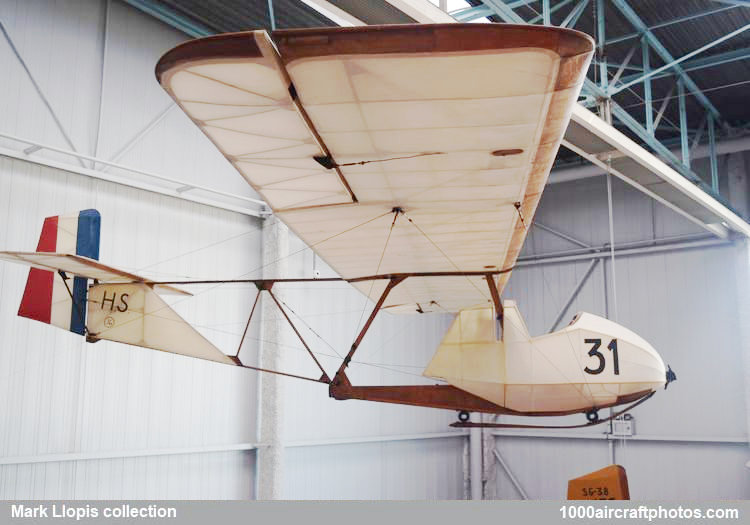
11/17/2026. Remarks by Johan Visschedijk: "In the spring of 1923 German Edmund Schneider, carpenter by trade, learned about unpowered flight and traveled to the Wasserkuppe in the Rhön region. He assisted in completing the Espenlaub 4 and Espenlaub 5, gliders designed by Gottlob Espenlaub himself, for the 1923 Rhön competition. In the autumn of 1923, Schneider and Espenlaub traveled to Grunau, near Hirschberg in Silesia (presently Jeżów Sudecki near Jelenia Góra, Poland). Schneider settled in Grunau and in 1928 he established his own company, Segelflugzeugbau Edmund Schneider, where Schneider developed the standard primary training glider ESG 9. In 1931 Schneider became famous with his Grunau Baby glider design of 1931, about 6,000 were built by twenty companies, of which approximately 3,000 were built by Schreiner's company in Grunau alone.
The SG 38 training glider, which entered service in 1938, is arguably one of the most widely used aircraft from the era of solo-flight training in the 1940s. Produced in large numbers, both in industrial settings and by amateur builders, this glider was primarily employed for ab initio (beginner) training. It also served as the primary training aircraft when gliding saw a resurgence in the 1950s.
The SG 38 was developed by a team at the Edmund Schneider aircraft factory in Grunau (now Jeżów Sudecki, near Jelenia Góra, Poland). This team included aircraft designer Edmund Schneider, designer and flight-test expert Rehberg, and production manager and glider pilot Ludwig Hofmann. In 1936, they started developing and subsequently testing several prototypes of what would become the SG 38 as early as 1937. The aircraft's certification was potentially secured following test flights conducted at the Rangsdorf flight training center, ca. 19 mls (30 km) south of Berlin, between December 6, 1937, and January 25, 1938 (with pilot Heinz Kensche), as well as subsequent flights in Grunau on April 14–15, 1938. These prototypes were reportedly designated Zögling 37C and Zögling 37D before the production models were given the designation SG 38.
The design proved successful, offering stable flight characteristics, even when handled by a novice student, as well as safety during landings. Furthermore, a significant degree of "washout" (wing twist) incorporated into the aileron sections ensured that the aircraft exhibited extremely forgiving stall characteristics, and it could withstand even rough landings. Few other gliders have been built or flown as extensively; thousands of pilots gained their first flying experience in an SG 38, which. became the most widely built aircraft used for solo flight training during the 1940s.
The single-seat, high-wing SG 38 glider was of wooden construction. It featured a truss-style fuselage, with a box-like structure containing the pilot's seat located in the forward section. It could be enclosed by a small cockpit fairing made of plywood and fabric, referred to as Kabin (or Boot), this version was designated SG 38K. The two-part wing featured a dual-spar structure and was equipped with ailerons; it was covered with plywood up to the first spar, and with fabric thereafter. The wing was braced by a system of wires, the upper ones attached to a pylon above the fuselage, and the lower ones secured to the fuselage frame. The tail assembly was of a conventional cruciform design, with the horizontal stabilizer supported by a single strut. The landing gear was of a single-track configuration, consisting of an oleo-pneumatic cushioned main skid beneath the fuselage and a tail skid. A hook for bungee-assisted launches was mounted on the forward skid.
The type certificate issued in 1938 by the testing authority for aeronautical equipment contained the restriction: Initial training only, no aerobatics, no aero-towing; permitted only for bungee, vehicle, or winch launches, with a maximum altitude of 300 m. Furthermore, these primary gliders typically lacked any flight instruments, and often even a cockpit, making it impossible to reliably assess the airspeed during flight. This restriction remains in effect in Germany today!
The designation Schneider SG 38 caused quite a bit of confusion. First, the abbreviation SG did not actually stand for Schulgleiter (training glider), but rather referred to Schneider of Grunau, the 38 denotes the year of its introduction, 1938. Furthermore, the RLM assigned to the aircraft the designations DFS 108-14 for the SG 38 and the 108-14 A for the SG 38K. Within this system, the overarching number 108 represented the category of gliders that were developed or certified, in part, by the DFS. The sub-number 14 served as the specific type identifier for the SG 38 within that series. In short: Schneider SG 38 (or Schneider SG 38K) were the company designations used by pilots and designers, DFS 108-14 (or DFS 108-14 A) were the bureaucratic government designations for the very same aircraft.
Production started in 1940, with 100 units manufactured that year, mass production was carried out by several firms, including Schneider, Klaus Flugzeugbau, Petersen Flugzeugbau, Ratjens Flugzeugbau, and the Oberlechner and Kartner facilities in Spittal an der Drau. In occupied Czech territory, production was initiated at the Ing. Mraz Flugzeugbau and Peter Flugzeugbau factories. The technical documentation was also provided to Slovakia, where the SG 38 was subsequently manufactured as well, while in the occupied Netherlands, the Pander company at The Hague also was forced to manufacture SG 38s. In 1942 Sweden also license-built the SG 38.
In addition to the approximately 8,750 units manufactured industrially during WW II, a considerable number SG 38 (or near-identical versions) were built in the decades that followed (a few were even built in the 21st century!) by companies, soaring clubs and/or individuals in a number of countries, including DDR (Deutsche Demokratische Republik, German Democratic Republic), Great Britain, Czechoslovakia, Poland and Spain. It is estimated that the total SG 38 versions produced since 1938 were approximately 10,000."