11/17/2026. Remarks by
Johan Visschedijk: "In 1928 Fokker built a small single-engine transport monoplane for use by newly founded airlines flying short routes with low-density traffic. This was the F.XI Universal which retained the wooden wing and fabric-covered welded steel-tube fuselage of the other Fokker transports, but differed from them in having a strut-braced two-piece wing which was attached to the upper longerons.
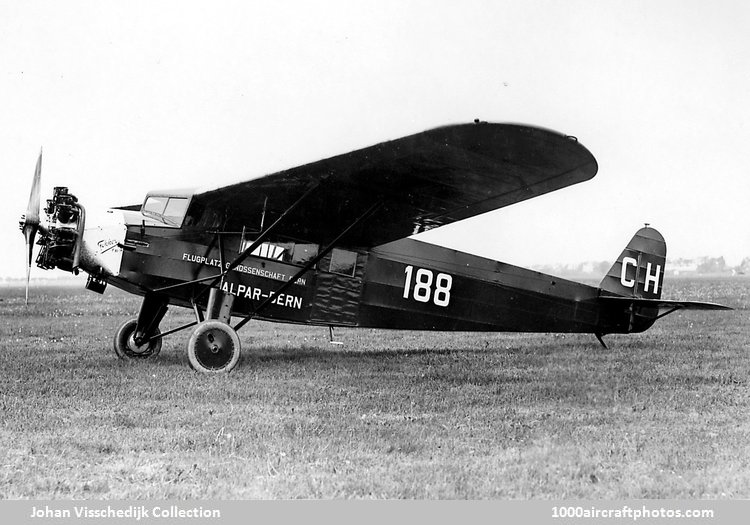
(CH-188) (
Johan Visschedijk Collection)
The Dutch-built Universal was similar to the US-designed Universal and Super Universal, but was really more of a cross between the two. The first of the Dutch F.XI Universals (c/n 5124) was powered by a 240 hp Lorraine 7Aa seven-cylinder air-cooled radial engine and had accommodation for two pilots and four passengers. It first flew early in 1929, and was delivered to Alpar of Berne that summer. It is believed to have been used on the Berne-Biel-Basle service as well as for joy rides over the Alps. This F.XI was originally registered CH-188 and later became HB-ALO.
In 1954 Alpar sold the aircraft to the Swiss company Centropatransit Handels AG, which made the F.XI available to the Austrian Alpine Alpine Rescue Guard rescue service. Since the aircraft was only sporadically required for rescue operations, it was also deployed for dropping sport parachutists, towing gliders and aerial advertising banners, and conducting sightseeing flights. In this way, the Universal model truly lived up to the versatility implied by its name. It was again reregistered in 1956, as OE-DAA.
The F.XI flew accident-free for a total of thirty years, until a careless recreational pilot parked his aircraft against it in1959. The resulting damage was beyond repair. Spare parts were no longer available, as Fokker’s Product Support department had reached the limits of its capabilities, but the F.XI was still at Linz in late 1965. Subsequently the aircraft was dismantled, the fuselage ended up temporarily in a playground, while the remaining parts were stored under a shelter.
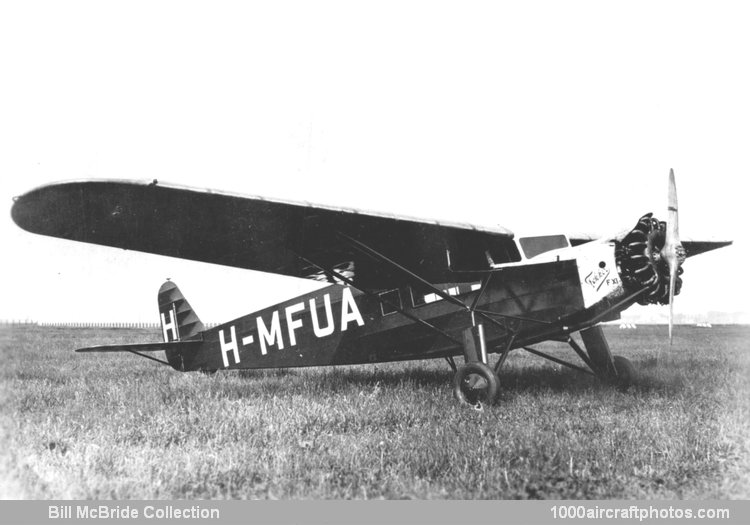
Only two other F.XIs were built. These were constructed in 1929 for Malért (acroniem of Magyar Légiforgalmi Rt., Hungarian Civil Aviation Company), delivered in 1930 and registered H-MFUA and H-MFUB (c/n 5125 and 5126). They were powered by 480/500 hp Gnome & Rhône Jupiter VI engines and had accommodation for two pilots and six passengers. The first aircraft was also used for pilot training, the second for topographic training. In 1932 the registrations were altered to HA-FUA and HA-FUB, the registrations were cancelled in 1938.