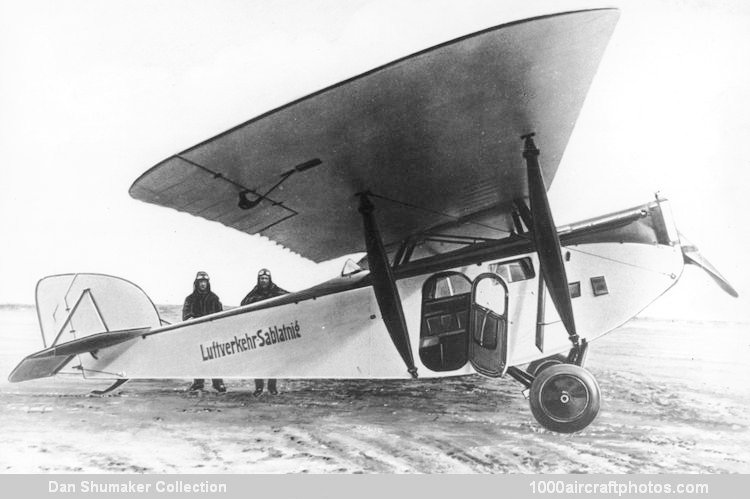
The P.III was originally designed to take either a 200/220 hp Benz Bz IV or 260 hp Maybach Mb IVa engine, and to be easily assembled and repaired, to provide the maximum safety for its occupants, and to have short take off and landing runs. It was of wooden construction with ply-covered fuselage and fabric-covered wings. The wings could be folded flat against the fuselage, the tailplane and elevators folded upward and the entire aircraft stowed in one standard German railway wagon. The inboard sections of the elevators could be locked at a preset angle for trim and also acted as air brakes.
A crew of two could be carried in a large open cockpit aft of the wing.The passenger seats were easily removed, allowing the aircraft to quickly transform into a cargo plane. A medevac version was also available, carrying one stretcher and two accompanying persons, as well as a version for aerial photography.
In June 1919 Lloyd-Luftverkehr Sablatnig was founded by Sablatnig Flugzeugbau and Norddeutscher Lloyd and in the following month opened a Berlin-Stralsund service, the route being extended to Copenhagen (Denmark) in September. A Berlin-Bremen service was also operated. Luftverkehr Sablatnig also flew holiday services to Norderney and Wangerooge. When the first P.III appeared it bore the words Luftverkehr-Sablatnig on its fuselage. At September 1921 the airline had a mixed fleet of seventeen aircraft and at least three of these, D-50, D-143 and D-171, were Sablatnig P.IIIs.
Twelve P.IIIs were assembled in Estonia by the company Dwigatel, fitted with balanced ailerons, six were used from 1923 by Aeronaut A/S on Esthonian domestic services and on the Tallinn-Riga route. These aircraft are believed to have been registered E-6 to E-11. In 1924 Aeronaut exchanged its Sablatnigs for Junker F 13s at the rate of two Sablatnigs for one Junkers.
Deutsche Lufthansa acquired nine or ten P.IIIs in 1926, and three of them were ex-Aeronaut aircraft. These Lufthansa aircraft were powered by a variety of engines, including the 240 hp Armstrong Siddeley Puma, the 220 hp BMW IV and 195/230 hp Junkers L 2. During the summer of 1928 they were used on the Munich-Regensburg-Nuremberg and Cologne-Krefeld services, but do not appear to have been used after that September. Six are known to have been dismantled by early in 1932, although one was in existence in 1936.
One P.III was fitted with a ski undercarriage in the winter 1920-21.
In Switzerland Alfred Comte's flying school owned a Maybach-powered P.III. It had clear-doped wings and was registered CH 54. This P.III had been bought to operate a Zürich-Constance service, which never took place, and was sold in 1921, probably to Germany."