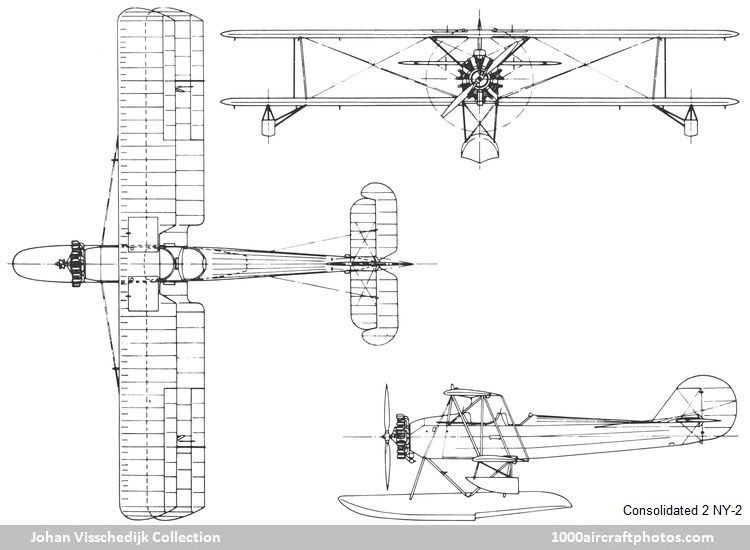
06/23/2025. Remarks by Johan Visschedijk: "In 1925, the Army PT-1 trainer had won against fourteen other proposals in the Navy's trainer competition. The Navy specified the 200 hp Wright J-4 (R-790) Whirlwind air-cooled radial engine, designed by Charles L. Lawrance of the Wright Aeronautical Corporation, for its Model 2 NY-1s. Provision was also made for the wheeled landing gear to be replaced by a single large float with wingtip stabilizing floats. A larger-area vertical fin and rudder was also fitted. Other change included the replacement of zinc plating with cadmium to prevent salt water corrosion.
The initial contract for forty was followed by 36 more. The first flight was made on November 12, 1925, by Lt. Carl A. Covey (USAAS) from Logan Field, St. Helena, Maryland, and the same day, Consolidated founder Reuben Fleet and Chief-Designer Virginius Clark delivered it to NAS Anacostia for acceptance trials. Converted to a seaplane, it was wrecked when it landed short of the water. Production examples were shipped to NAS Pensacola, Florida, in May 1926.
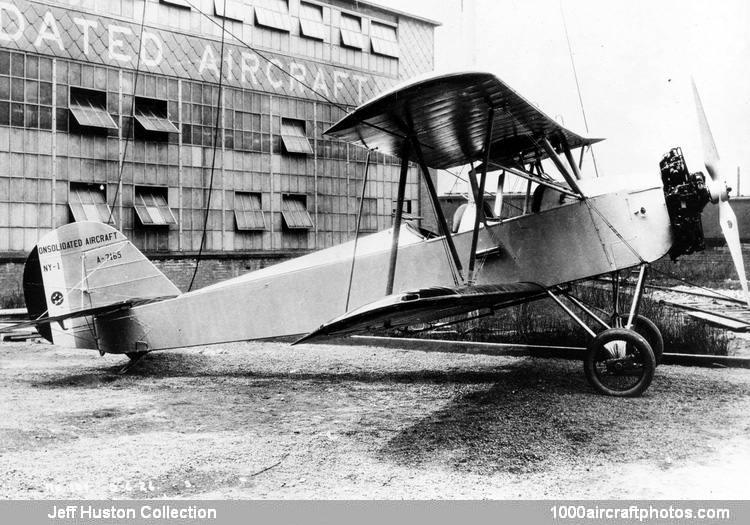
The photo on top of the page shows the factory-fresh third NY-1 A-7165 at the Consolidated Aircraft plant at Buffalo, New York, in May 1926. The aircraft was assigned to the US Naval Reserve Aviation Unit at Sand Point, Washington. A year later, May 26, 1927, the aircraft was destroyed in a landing accident at its home base.
The designation NY-1A was applied to an unknown number of NY-1 aircraft, who were fitted with a 0.30 in (7.62 mm) gun on a dorsal mounting for use as gunnery trainers, some were later converted to NY-2 standard as NY-1Bs. The unofficial name of 'Husky' was used for the radial-engined versions and ATC 80 was awarded to the NY-1 series in November 1928.
In October 1926, 40 ft (12.19 m) span wings were built to improve wing loading and these, with the more powerful 220 hp Wright J-5 (R-790-8), were fitted to 181 NY-2s. One NY-2 (A-7463) was fitted with a 300 hp Wright R-975 engine and was designated XNY-2. Subsequently it was transferred to the USAAC and serialed 30-421 it was tested at McCook Field, Ohio, with Project Number "P-589". The NY-2 was awarded the ATC 81 in November 1928. An additional 25 NY-2A gunnery trainers and twenty NY-3s with 240 hp Wright R-790-94 engines for USN and USMC reserve squadrons were delivered starting 1929.
Because of its stable flying qualities, a civil NY-2 was registered in 1929 as NX7918 to the Daniel Guggenheim Fund's Full Flight Laboratory at Mitchel Field, Garden City, Long Island, New York, for research of 'blind-flying'. The historic first 'blind-flying' demonstration flight, including take off and landing, took place on September 24, 1929, with USAAC Lt. James H Doolittle at the controls under in the hooded rear cockpit, with Lt. Ben Kelsey as a safety pilot in the open front cockpit. The prescribed 20 mls (32.18 km) flight lasted 15 minutes. The first solo 'blind-flying' flight was made, also with a NY-2, at McCook Field, Ohio on May 9, 1932, pilot was USAAC Captain Albert Francis Hegenberger.
Over 100 NY-2/3s were in active service in 1929, with 35 more assigned to reserve units and fifteen remained in 1937, with one still active in 1939."